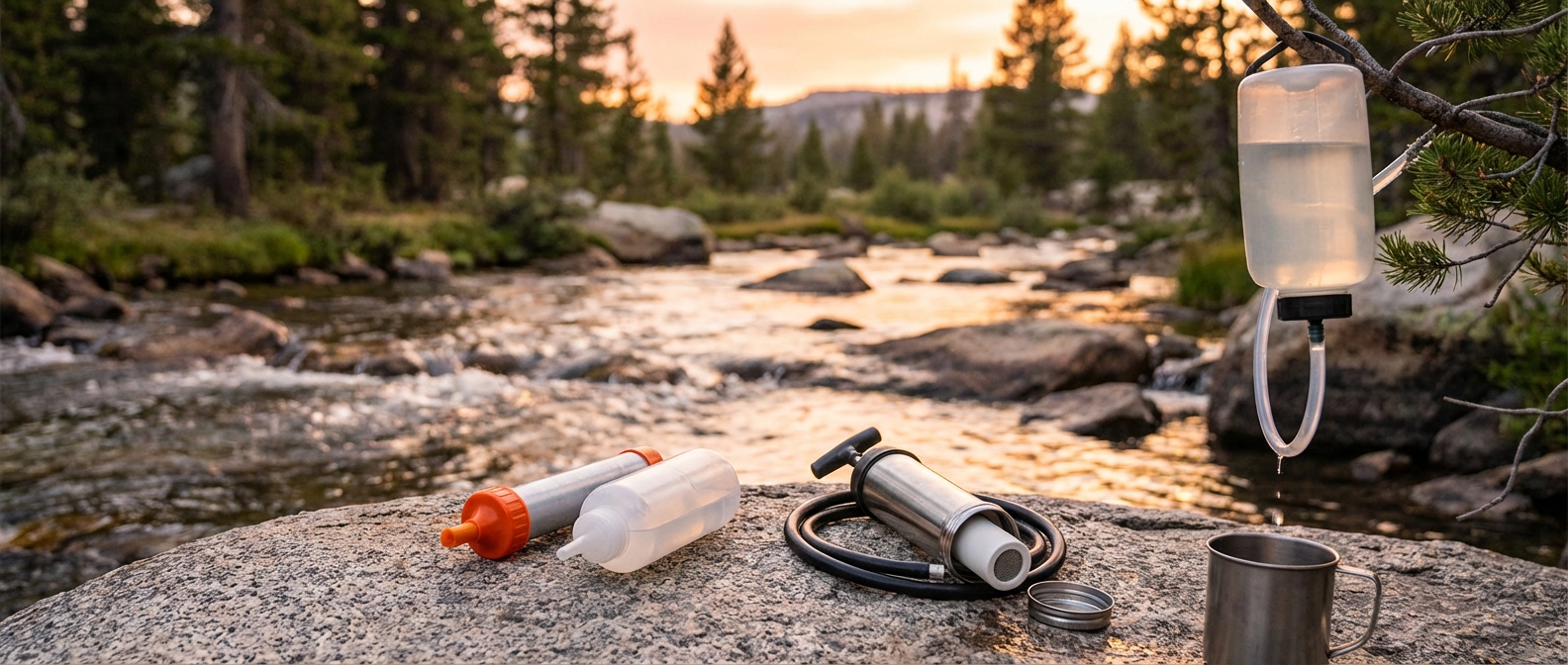
Best portable water filters for travel, hiking, and emergency preparedness
Quick answer / TL;DR
- Best overall: Sawyer Squeeze: hollow-fiber squeeze filter with long rated life and backflushable design.
- Best budget backup: LifeStraw Personal: ultralight straw for emergency use.
- Best fast-trail flow: Katadyn BeFree: soft-flask hollow-fiber with high flow for quick refills.
- Best premium convenience: GRAYL GeoPress: press-style purifier; verify independent lab data for viral and chemical claims.
- Best rugged pump for groups: MSR MiniWorks EX: durable hand pump with ceramic plus carbon element.
Choose hollow-fiber squeeze or soft-flask systems for the best balance of weight, flow, and lifetime. Carry a LifeStraw-style straw as an ultralight backup. Use a pump for groups. Use a purifier-class device when viruses or chemicals are likely. Verify viral and chemical claims with independent third-party lab reports.
When to use each type
- Solo day hikes and backpacking: lightweight hollow-fiber squeeze or soft-flask filters.
- Ultralight emergency kit: straw-style filters for immediate short-term use.
- Fast trail sections: soft-flask filters that allow quick fills and fast flow.
- International travel with suspect municipal water: purifier-rated devices or a layered approach combining filtration with UV or chemical treatment.
- Group or basecamp use: pump filters and larger gravity systems.
Key definitions
- Filter vs purifier: a filter removes particles, bacteria, and protozoa by mechanical means. A purifier also removes or inactivates viruses. Look for documented viral log reduction values.
- Log reduction: a quantitative measure of pathogen reduction. For example, 3-log equals 99.9 percent removal.
- Hollow-fiber membrane: tiny tubular pores that mechanically block microbes.
- Activated carbon: adsorbs chlorine, improves taste, and removes some organic chemicals.
- UV inactivation: UV-C light inactivates microbes but does not remove particles or chemicals.
What common technologies typically remove
| Technology | Mechanism / pore size | Typically removes | Does not reliably remove |
|---|---|---|---|
| Hollow-fiber membrane | ~0.1–0.2 μm pores | Bacteria, protozoa, sediment | Viruses, dissolved chemicals, salts, many heavy metals |
| Ceramic element | Microporous ceramic | Bacteria, protozoa, sediment; can be cleaned | Viruses, dissolved chemicals unless combined with other media |
| Activated carbon | Adsorption | Chlorine, tastes, many organics | Microbes (alone), salts, some heavy metals |
| Press-style cartridges | Varies by cartridge chemistry | Depends on cartridge; can include microbes and organics | Varies; verify with third-party tests |
| UV devices | UV-C inactivation | Bacteria, protozoa, many viruses if water is clear | Particulates, dissolved chemicals; effectiveness drops in turbid water |
Mechanical filters reliably remove bacteria and protozoa. Carbon improves taste and reduces some chemicals. Viruses, dissolved salts, many heavy metals, and industrial chemicals usually require purifier-rated devices or additional treatment.
At-a-glance picks: best portable water filters
Verify viral and chemical claims with independent lab reports before relying on any device for those hazards.
-
Sawyer Squeeze: hollow-fiber squeeze
- Removes: bacteria, protozoa, sediment
- Pros: lightweight, modular, backflushable, long rated lifetime
- Cons: flow slows without maintenance
-
LifeStraw Personal: straw-style hollow-fiber
- Removes: bacteria, protozoa
- Pros: very light, simple emergency backup
- Cons: not suitable for filling containers or groups; not a virus/chemical purifier
-
Katadyn BeFree: hollow-fiber in soft-flask
- Removes: bacteria, protozoa, sediment
- Pros: high flow, packable, fast refills
- Cons: soft-flask durability varies; filter life affected by water quality
-
GRAYL GeoPress: press-style purifier (cartridge varies)
- Removes: depends on cartridge; may claim broader contaminant removal
- Pros: single-press convenience, improved taste
- Cons: heavier and pricier; verify independent lab results for viral and chemical removal
-
MSR MiniWorks EX: hand pump with ceramic plus carbon
- Removes: bacteria, protozoa, sediment; carbon improves taste
- Pros: durable, field-serviceable, good for groups
- Cons: heavier, manual pumping required
How to choose the best portable water filter for your needs
Decision checklist:
- Identify hazards on your route: bacteria and protozoa, viruses, or chemicals and heavy metals.
- If viruses or chemicals are likely, choose a purifier-rated device or plan a layered approach that adds UV or chemical treatment to a mechanical filter.
- Match form factor to use: straw for ultralight backup, squeeze or soft-flask for solo hiking, pump for groups, press bottle for travel convenience.
- Consider weight, packability, maintenance (backflushing and spare parts), and rated lifetime.
- Obtain and review independent third-party lab reports and log-reduction numbers for target organisms.
- Carry a backup method: tablets, boiling capability, or a UV device.
Quick pointers:
- Solo ultralight hiking: hollow-fiber squeeze or soft-flask.
- International travel where tap water is suspect: purifier or filter plus UV or chemical layer.
- Group and basecamp use: pump or larger gravity systems.
- Emergency kit: LifeStraw plus tablets as backup.
Certifications and testing to look for
- NSF/ANSI 42 and 53: focus on taste, odor, and some chemical reductions.
- NSF P231: covers microbiological purifiers. Look for specific log-reduction claims for bacteria, protozoa, and viruses.
- Trusted third-party testers: Intertek, SGS, Eurofins, NSF, and university or government labs.
Request full third-party lab reports from manufacturers that show log reductions for specific organisms and chemicals. Treat unverified claims about viruses or chemicals as unconfirmed until you see the data.
Use, maintenance, and realistic lifespan
- Backflush hollow-fiber filters regularly to restore flow. Follow manufacturer instructions for ceramic cleaning and cartridge replacement.
- Lifespan ratings range from hundreds to thousands of liters. Expect shorter life with turbid water and poor maintenance.
- Prevent freeze damage. Many hollow-fiber filters are permanently damaged if water freezes inside. Drain and store according to the manufacturer’s guidance.
- Troubleshooting: low flow usually means clogging. Backflushing or cleaning often restores performance.
Portable filters versus other methods
- Boiling: reliably inactivates microbes including viruses when done correctly. It does not remove particles or chemicals and requires fuel and time.
- Chemical treatments (iodine, chlorine dioxide): effective against most microbes, including some viruses, when used with correct contact time. They work poorly in turbid water and can affect taste.
- UV devices: fast in clear water. They require power and do not remove particles or chemicals.
Use mechanical filtration first to remove turbidity, then add UV or chemical treatment when viral protection is needed.
FAQ (short answers)
Q: Are portable water filters necessary for emergency preparedness?
A: Yes. If municipal supply fails or is contaminated, a portable filter plus a backup treatment lets you obtain safer water from natural sources.
Q: Do portable filters remove viruses?
A: Most hollow-fiber and ceramic filters do not reliably remove viruses. Use a purifier-rated device or add UV, chemicals, or boiling for viral protection.
Q: How long do portable water filters last?
A: Lifespan depends on model, maintenance, and source water. Manufacturer-rated liters are a baseline. Heavy sediment and poor maintenance shorten life.
Q: Should I carry purification tablets too?
A: Yes. Tablets are a compact backup for filter failure, freezing, or when viral protection is needed and your filter is not rated for viruses.
Practical buying tips
- Read multiple independent reviews and request published lab-test reports for microbial and chemical performance.
- Confirm replacement cartridge availability and cost before buying.
- Practice using the filter and performing maintenance at home.
- Keep at least one backup treatment method: tablets, a UV device, or the ability to boil water.
- For international travel, check CDC, EPA, and WHO advisories and adapt equipment accordingly.
Which is right for you
- Beginners and general outdoor use: Sawyer Squeeze. Balanced, proven, and modular.
- Personal emergency backup: LifeStraw. Ultralight and simple; not a virus or chemical purifier.
- Fast trail use: Katadyn BeFree. High flow and easy refilling.
- Travel with chemical or virus concerns: GRAYL GeoPress. Convenient but verify independent lab results.
- Rugged camp and group use: MSR MiniWorks EX. Reliable and serviceable.
Next steps
- Identify the primary hazards for your trips.
- Choose a primary filter that addresses those hazards or plan a layered approach.
- Obtain and review independent third-party lab reports for any device you will rely on for viral or chemical protection.
- Pack a backup method and practice using everything before you need it.
- Store spare cartridges and parts if you expect extended use.