Quick Answer (TL;DR)
A family communication plan is a short, written set of instructions that tells household members who to contact, how to contact them, where to meet, and what backups to use if phones or power fail. Create one:
- Choose an out-of-area contact
- Assign roles and primary and backup methods
- List meeting points with exact addresses and contact info
- Make wallet cards and a home binder
- Test and update it regularly
Family communication plan for emergencies: how to create and test yours
A clear family communication plan tells everyone who they should contact, which tools to use, where to meet, and what backups exist when phones or power fail. It reduces confusion and speeds reunification. Start small. Pick an out-of-area contact, define methods and roles, write meeting places, make wallet cards, and run drills twice a year.
Verify sources
If you cite FEMA, NIST, or other official guidance, include the year and a URL for each statistic before publishing.
What is a family communication plan?
A family communication plan is a written, agreed set of steps that explains:
- Who to contact during an emergency
- Which primary and backup communication tools to try
- Where to meet if household members are separated
- How to handle special needs, medical issues, and pets
Treat it as a short roadmap to follow under stress.
Why a family communication plan matters
- Avoid duplicate efforts and unnecessary calls
- Speed coordination for evacuation or shelter-in-place
- Confirm safety with fewer messages and clearer updates
- Provide alternatives when cell networks are congested or offline
Agencies that provide templates and guidance include FEMA, the American Red Cross, local emergency management, and CERT.
Key elements of a usable family communication plan
- Out-of-area contact: name, relationship, phone, email, city and state
- Primary contact methods: voice calls, SMS, family group apps
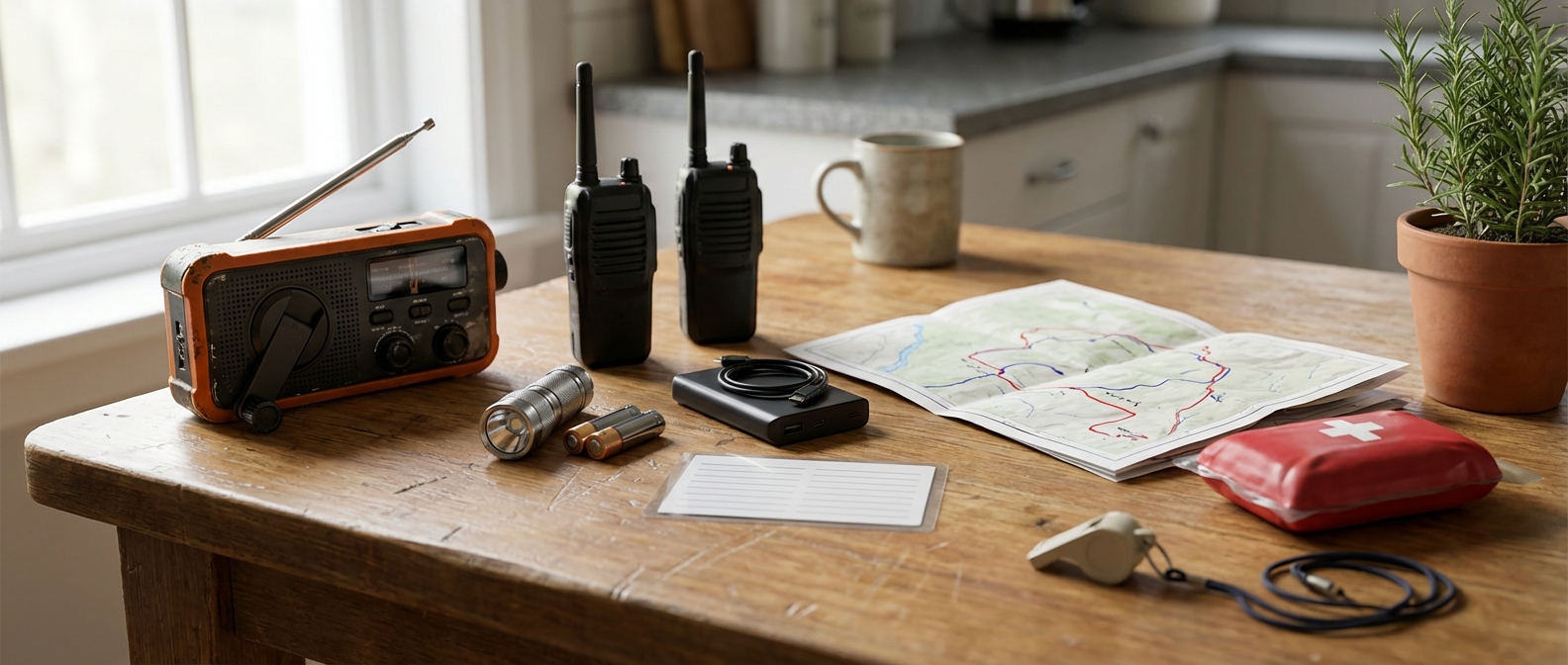
- Backup methods: email, social media, two-way radio, satellite communicator
- Roles: who calls the school, who checks on elders, who updates social channels
- Meeting points: near-home, neighborhood, out-of-area with exact addresses
- Emergency info: allergies, medications, disabilities, physician contact
- Documents: wallet cards, home binder, encrypted or shared digital copy
- Review schedule: dates for testing and updates
Step-by-step: create your family communication plan
-
List every person to include
- Household members, caregivers, babysitters, neighbors, schools, workplaces.
-
Choose an out-of-area contact
- Pick someone outside your region to act as a central check-in point. Record phone, email, and preferred check-in times.
-
Decide primary and backup methods
- Primary: voice calls, SMS, or a family group app.
- Backups, tiered by availability: SMS or push messages, email or social posts, two-way radio, satellite communicator.
- Agree on a simple status format. Examples: “OK”, “Need Help”, “Location: [address]”.
-
Assign roles and backups
- Keep roles short and specific: who contacts the school, who notifies relatives, who gathers pets.
- Give each role a backup person.
-
Set meeting points with exact addresses
- Near-home: a clear, easy landmark.
- Neighborhood: a local park or community center with an address.
- Out-of-area: a relative’s or friend’s address.
-
Make contact cards and an emergency binder
- Wallet cards: name, guardians, primary and out-of-area contact, meeting points, allergies.
- Binder: printed contacts, medical info, copies of important documents.
- Keep an encrypted digital copy in a shared folder.
-
Plan for special circumstances
- Children: school pickup procedures and authorized names.
- Older adults or people with disabilities: accessible transport and caregiver contacts.
- Non-English speakers: translated key phrases and instructions.
- Pets: pet-care plan, carrier location, and any medications.
-
Store copies in multiple places
- Wallets, backpacks, on the refrigerator, in an emergency bag, and with your out-of-area contact.
Tools and resources (quick reference)
- Cell phones: everyday use; limited by battery and network.
- SMS: reliable for short status updates during congestion.
- Group apps (WhatsApp, Signal): group coordination and location sharing; needs data.
- Two-way radios: local coordination without cellular networks.
- NOAA weather radios: one-way official alerts.
- Satellite communicators: work in remote areas or wide outages; cost and subscriptions apply.
- Printed contact sheets and binders: low-tech backup that works without power.
Templates: FEMA and the American Red Cross publish printable family communication plan templates. Add year and URL when you link to them.
Testing and updating your family communication plan
Drills to run:
- Text-only drill: send a standard message and require a simple reply.
- Call-tree drill: one person calls two people; each of those calls two more.
- Meeting-point drill: everyone meets at the near-home spot.
- Power-out drill: disable Wi-Fi and mobile data briefly and test backups.
- School-day pickup drill: simulate a pickup disruption and follow the plan.
Review schedule and triggers:
- Routine review: every 6 to 12 months.
- Update after moving, job or school changes, new phone numbers, or other household changes.
- Update before local hazard seasons such as hurricane, wildfire, or winter.
Tips to keep the plan usable:
- Keep a one-page quick reference for wallets and backpacks.
- Use waterproof sleeves for printed copies.
- Review the plan with babysitters, caregivers, and frequent visitors.
- Practice with the real devices and apps your family uses.
FAQ (short answers)
Q: What is a family communication plan? A: A written set of instructions for contacting family members, where to meet, and what backups to use during emergencies.
Q: Who should be the out-of-area contact? A: A trusted friend or relative outside your immediate region who can act as a central check-in point.
Q: What if cell service is down? A: Use prearranged meeting points, two-way radios, NOAA alerts, or a satellite device. Printed plans are crucial.
Q: How often should we practice? A: At least once or twice a year, and whenever contact details or household members change.
Quick checklist to start this week
- Choose an out-of-area contact (name, phone, email)
- Write exact meeting addresses (near-home, neighborhood, out-of-area)
- Create wallet cards and a one-page reference
- Assign communication roles and backups
- Run a simple text-only drill
Takeaway
A family communication plan takes little time to create and pays off during an emergency. Keep it simple, update it regularly, and practice with your family. A one-page reference and wallet cards make the plan easy to use when it matters.
Fact-check notes
- Verify any FEMA statistic about the percentage of people without a plan. Include the year and URL.
- If you cite NIST or other research on response times or coordination benefits, provide the specific study reference and link.