When It Happened Before
In December 2001, Argentina’s economy didn’t just stumble — it fell off a cliff. The government froze all bank accounts in a measure called the corralito, locking middle-class families out of their own savings overnight. People who had $50,000 in the bank on a Monday couldn’t withdraw more than $250 a week by Tuesday. The peso, which had been pegged 1:1 to the US dollar for a decade, was devalued by 75% in weeks. GDP plummeted 28% between 1998 and 2002. Unemployment hit 25%. The country cycled through five presidents in ten days. Supermarkets were looted. The middle class — doctors, teachers, engineers — found themselves dumpster diving. This wasn’t a developing-world problem. Argentina had been one of the ten wealthiest nations on Earth at the start of the 20th century. The people who got hit hardest were the ones who trusted the system completely: kept their money in banks, carried no debt provisions, and assumed the rules wouldn’t change. The rules always change.
Venezuela makes Argentina look like a dress rehearsal. Starting around 2013, a combination of oil price collapse, catastrophic fiscal policy, and corruption sent the economy into a death spiral that’s still spinning. Hyperinflation peaked at over 1,000,000% in 2018 — a number so absurd it barely registers as real. Grocery shelves went bare. The medical system collapsed so thoroughly that hospitals performed surgeries without anesthesia and patients brought their own sutures. More than 7 million Venezuelans have fled the country — roughly a quarter of the population — making it one of the largest displacement crises in the Western Hemisphere. People with advanced degrees crossed borders on foot carrying what they could in backpacks. The bolívar became so worthless that street vendors used stacked bills as napkin holders. The warning signs were there for years. Most people saw them and thought, it can’t get that bad here.
And then there’s Weimar Germany, the textbook case everyone references but few truly internalize. Between 1921 and 1923, hyperinflation rendered the German mark essentially fictional. A loaf of bread that cost 250 marks in January 1923 cost 200 billion marks by November. Workers were paid twice a day so they could sprint to the store before prices doubled again. People wallpapered their homes with banknotes because the paper was cheaper than actual wallpaper. Some literally burned currency for heat — it had more value as kindling than as money. The life savings of an entire generation evaporated. What rose from those ashes was political extremism, desperation, and eventually something far worse. Economic collapse doesn’t just empty your bank account. It reshapes societies.
How Much Warning You’ll Actually Get
Here’s the uncomfortable truth about economic collapse preparedness: the warning signs are usually measured in months or years, but the actual breaking point — the moment the ATM says “service unavailable” or the currency loses half its value — can happen in days or even hours. Argentina’s corralito was announced on a Saturday. Venezuela’s inflation didn’t go from 0 to a million percent overnight, but there were specific weeks where the price of eggs doubled, then doubled again, then became irrelevant because the eggs were gone. The Great Depression gave signals too — bank failures were cascading through 1930 and 1931, and yet 9,000 banks still failed before it was over because people kept believing the next one wouldn’t be theirs.
The signals you should be watching are not subtle if you know where to look: sustained inflation above central bank targets, currency devaluation against major foreign currencies, rising government debt-to-GDP ratios, capital controls being discussed or implemented, banks tightening withdrawal limits, and — perhaps the clearest signal of all — wealthy people and institutional investors quietly moving assets offshore. When the smart money leaves, you should already have your plan in place. The difference between urban and rural matters here too. In cities, the effects hit faster and harder — supply chains are longer, dependency on cash systems is greater, and population density makes civil unrest more dangerous. Rural communities historically fare better, not because they’re immune, but because they’re closer to food production and tend to have stronger neighbor-to-neighbor networks. The window between “things are getting weird” and “things are broken” is smaller than you think. Your preparation needs to happen while the economy still functions well enough to let you prepare.
The First 72 Hours
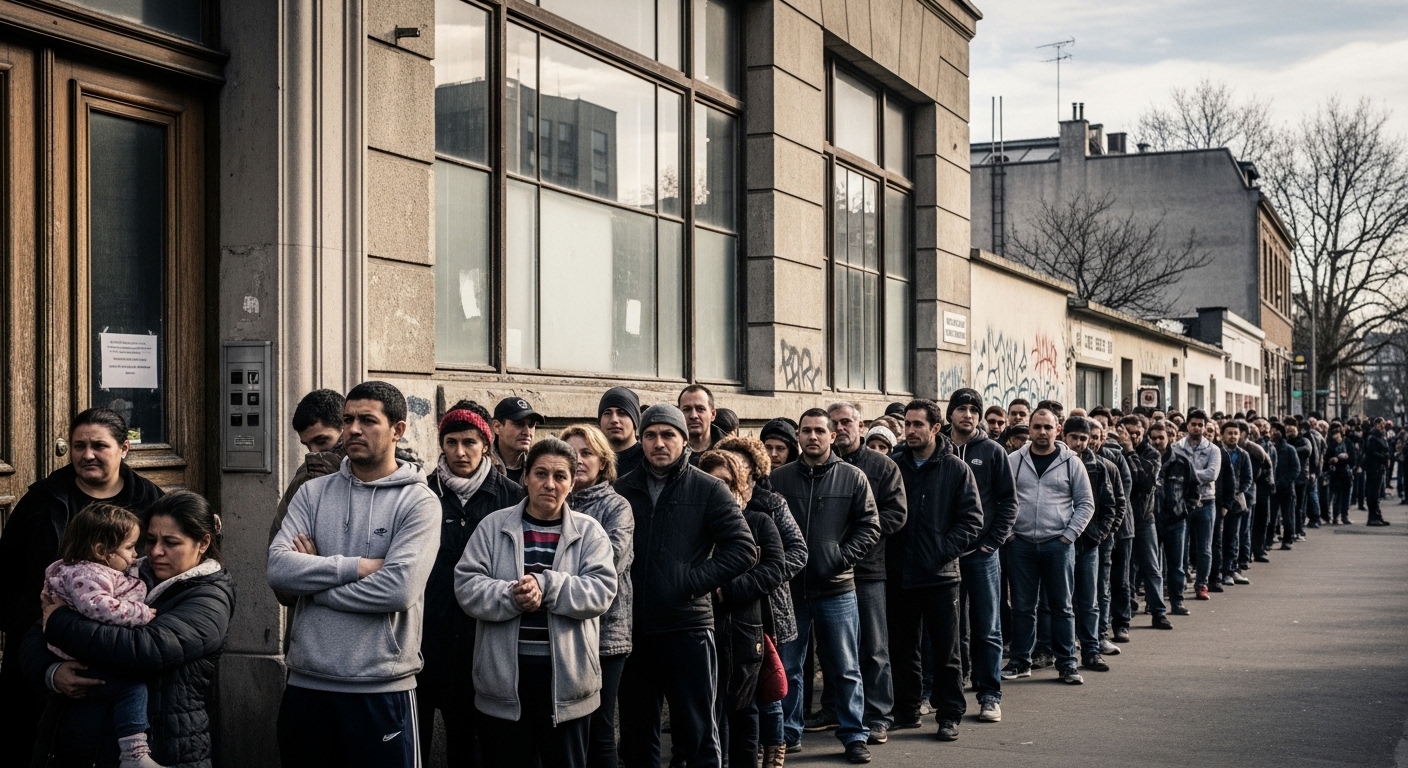
The first hours of an economic crisis don’t look like a disaster movie. They look like confusion. Maybe you wake up to news that a major bank has frozen withdrawals, or the government has announced emergency currency controls, or inflation figures came in so hot that the stock market is in freefall before lunch. The immediate threat isn’t violence — it’s access. Access to your money, access to goods, access to fuel. In Argentina, people crowded around ATMs that dispensed nothing. In Venezuela, people who arrived at the grocery store an hour after a price adjustment found shelves stripped bare by those who got there first. Your first move in the opening hours is not to panic-buy — it’s to calmly execute the plan you already have. If you’ve done your economic collapse preparedness homework, you have cash on hand, you have food stored, and you have a clear picture of your financial exposure.
In the first 24 hours, withdraw what cash you can while ATMs still work — prioritize small bills. Fill your vehicle’s gas tank and any fuel containers you have. Make contact with your immediate network: family, trusted neighbors, anyone you’ve discussed contingency plans with. Do not go to crowded commercial areas if you can avoid it. The people who get hurt in the first day aren’t usually victims of organized violence — they’re caught in panicked crowds at banks, gas stations, and supermarkets. If you’re carrying debt with variable interest rates, understand that those rates may spike dramatically and quickly. There’s nothing you can do about that in 72 hours, but you need to mentally prepare for the financial pressure that’s coming.
By day two and three, the picture clarifies. Either the government intervenes with emergency measures — which historically means capital controls, price freezes, or both — or the freefall continues. Price freezes sound comforting until you realize they cause merchants to stop selling goods entirely, because selling at a loss is worse than not selling at all. This is exactly what happened in Venezuela: the government mandated prices, and producers simply stopped producing. The threat in this window isn’t starvation — it’s the psychological shock of realizing the systems you relied on are no longer reliable. The people who navigate these 72 hours best are the ones who recognized this possibility before it arrived. If you’re just starting to think about preparedness, our beginner’s guide to survival readiness covers the foundational mindset you need.
When Days Become Weeks
After the initial shock, the economy enters a grinding phase that’s far more dangerous than the acute crisis. This is when supply chains begin to visibly fracture. Imported goods disappear first — in countries dependent on foreign manufacturing (which is most countries, including the United States), this means electronics, medications, vehicle parts, and specific food items vanish from shelves. Domestic production slows because businesses can’t secure raw materials, can’t pay workers in currency that holds value, or simply can’t operate under the new economic reality. Fuel shortages cascade into everything: if trucks can’t run, stores can’t stock. If stores can’t stock, people get desperate. If people get desperate, security becomes your primary concern. In Argentina, home invasions spiked dramatically in the months following the crash. In Venezuela, violent crime became so endemic that entire neighborhoods organized citizen watch groups — not as a hobby, but as a survival requirement.
The medical system degrades on a timeline that should alarm anyone with chronic health conditions. Pharmacies run out of imported medications within weeks. Hospitals begin rationing supplies. Elective procedures stop, then non-emergency procedures stop, then the definition of “emergency” starts shifting upward. This is the window where food stockpiles prove their worth — not as some doomsday fantasy, but as a practical buffer that reduces your need to interact with an increasingly unstable marketplace. Every meal you can pull from your pantry is a trip you don’t have to make to a store where prices change daily and tempers are short. Your productive assets — a vegetable garden, backyard chickens, the ability to repair things — transition from hobbies to genuine economic advantages. The barter economy begins to emerge naturally, neighbor by neighbor, need by need. Understanding how bartering actually works before you need it is the difference between getting fair trades and getting taken.
Long-Term: If It Doesn’t Resolve Quickly
The Great Depression lasted a decade. Venezuela’s crisis is entering its second decade with no resolution in sight. Argentina’s 2001 collapse took years to stabilize, and the country has experienced recurring economic crises since — including inflation above 100% again in 2023. The historical record is clear: economic collapses rarely resolve quickly, and the recovery rarely returns you to the previous normal. When Weimar Germany’s hyperinflation was finally arrested in late 1923 through the introduction of a new currency, the damage was permanent — an entire generation’s savings had been obliterated, trust in institutions was shattered, and the political radicalization that followed reshaped the world. In the US Great Depression, unemployment remained above 14% for an entire decade, and it took World War II’s industrial mobilization — not economic policy — to finally restore full employment. During those years, 25% of Americans were jobless at the peak, Dust Bowl conditions compounded food insecurity across the Great Plains, and the people who survived best were those with practical skills and productive land.
Long-term economic collapse changes the fabric of daily life in ways that are hard to appreciate from a position of stability. Formal employment becomes scarce; informal and black-market economies expand. Currency may stabilize at a much lower value, or a parallel currency system may emerge — in Venezuela, the US dollar became the de facto currency for any serious transaction. Social structures shift: professionals take manual labor jobs, families consolidate into single households to share costs, and emigration becomes a survival strategy rather than an aspiration. New threats emerge too — organized crime fills vacuums left by underfunded police, political instability increases, and the psychological toll of sustained economic stress manifests as depression, substance abuse, and family breakdown. Economic collapse preparedness isn’t just about the first week. It’s about building a life that can absorb years of disruption. This means prioritizing fundamental skills and self-reliance over gadgets and gear.
Your Economic Collapse Preparedness Checklist
Before — Building Your Foundation Now
- Diversify your savings across asset types. Don’t keep everything in one bank or one form. Maintain a mix of physical cash (at home, secured), precious metals, and — if you’re comfortable with the technology — a modest position in cryptocurrency. No single asset class is collapse-proof, but diversification means no single failure wipes you out.
- Hold physical cash in small denominations. When electronic payment systems go down or merchants can’t make change, $1s, $5s, and $10s are king. Keep at least one month’s expenses in small bills, stored securely at home. During Argentina’s corralito, people with physical cash had purchasing power that people with six-figure bank balances did not.
- Buy gold and silver in small denominations. One-ounce gold bars are impressive but impractical for buying groceries. Focus on pre-1965 US silver coins (junk silver), 1/10 oz gold coins, and 1 oz silver rounds. These are recognizable, divisible, and have historically held purchasing power through currency collapses.
- Consider holding some foreign currency. In Venezuela, US dollars became the real economy. In Argentina, dollar-holders preserved their wealth while peso-holders lost everything. A modest amount of stable foreign currency (USD, Swiss francs, euros) provides a hedge.
- Eliminate or minimize debt aggressively. Interest rates spike during economic crises. That variable-rate mortgage or credit card balance can become unpayable overnight. Debt is a vulnerability — reduce it now while your income is stable.
- Build a deep food stockpile. A three-to-six-month supply of shelf-stable food reduces your dependence on a functioning economy. Rice, beans, canned goods, cooking oil, salt, honey — boring but effective. Every meal from your stockpile is a meal you don’t have to buy at hyperinflated prices.
- Develop skills with barter value. Medical knowledge (even basic first aid and herbalism), mechanical repair, electrical work, agriculture, sewing, food preservation, and firearms maintenance are all skills that translate directly into value when currency doesn’t. Skills can’t be confiscated, frozen, or devalued.
- Invest in productive assets over consumer goods. A vegetable garden, fruit trees, laying hens, a well-maintained set of hand tools, and seed stock are worth more in a prolonged crisis than any consumer purchase. These assets generate ongoing value rather than depreciating.
- Build community relationships now. Barter networks, mutual aid agreements, and trusted neighbor relationships form organically — but they form from pre-existing connections. Know your neighbors. Share skills. Establish trust before you need it. The lone wolf fantasy is exactly that — a fantasy.
- Secure important documents. Passports, birth certificates, property deeds, insurance policies — have physical copies in a fireproof safe and digital backups. If emigration becomes necessary (as it did for 7 million Venezuelans), documentation is everything.
- Maintain a supply of trade goods. Alcohol, tobacco, coffee, batteries, lighters, over-the-counter medications, and hygiene products become high-value barter items when supply chains fail.
During — Immediate Response When Crisis Hits
- Withdraw available cash immediately — ATMs and banks may freeze access within hours of a major announcement. Don’t wait for confirmation; act on early signals.
- Top off all fuel — vehicles, generators, propane, stored fuel. Fuel is one of the first commodities to become scarce or price-gouged.
- Contact your network. Confirm plans with family and trusted community members. Establish communication schedules if you anticipate disruption.
- Inventory your supplies. Know exactly what you have and how long it lasts at current consumption rates. Begin rationing non-essentials immediately.
- Avoid crowds and commercial districts. The risk-to-reward ratio of fighting panicked crowds at Costco is terrible. If you’ve prepared, you don’t need to be there.
- Secure your property. Increase visible and actual security. Economic desperation drives property crime before anything else.
- Monitor reliable information sources. Government announcements, central bank actions, and international reporting — not social media rumors. Bad information kills preparedness plans.
- Convert vulnerable assets. If you still have time, convert cash savings above your emergency reserve into tangible goods, precious metals, or foreign currency.
After — Recovery and Adaptation
- Engage in the barter economy carefully. Start with people you know. Establish fair exchange rates based on mutual need, not desperation. Never reveal the full extent of your supplies.
- Protect productive assets. Your garden, livestock, and tools become targets as scarcity increases. Security is an ongoing concern, not a one-time setup.
- Reassess financial exposure regularly. As new currencies, policies, or economic structures emerge, adapt your strategy. The post-collapse economy will have different rules.
- Document everything. Keep records of trades, assets, and agreements. When formal systems return — and they eventually do — documentation matters for legal and tax purposes.
- Maintain physical and mental health. Extended economic stress is a marathon, not a sprint. Routine, exercise, social connection, and purpose are not luxuries — they’re survival tools.
- Watch for recovery opportunities. Those who maintain resources and skills through the worst of a collapse are positioned to rebuild when stabilization begins. In every historical example, the recovery phase created new opportunities for those who were prepared.
What Most People Get Wrong
The biggest misconception about economic collapse preparedness is that it’s about buying gold and building a bunker. It’s not. The people who survived Argentina, Venezuela, and every other modern economic collapse best were not the ones with the most stuff — they were the ones with the most adaptability and the strongest networks. A thousand ounces of silver doesn’t help you if your neighbor with medical skills won’t trade with you because you’ve been a stranger for ten years. A year’s supply of freeze-dried food doesn’t help if you have $200,000 in variable-rate debt that triples your monthly payments when interest rates spike. People over-index on dramatic preparations and under-invest in the boring fundamentals: eliminating debt, growing food, learning practical skills, and knowing the people who live within walking distance.
The other critical error is assuming it can’t happen here — wherever “here” is for you. Argentina’s middle class thought the same thing. They had good jobs, savings accounts, and faith in their institutions. Venezuela was the wealthiest country in South America before it wasn’t. The United States isn’t immune to economic disruption; it’s simply been fortunate in its timing and reserve currency status. That status isn