DIY Water Filter: Make a Simple Emergency Filter from Household Items
Quick instructions
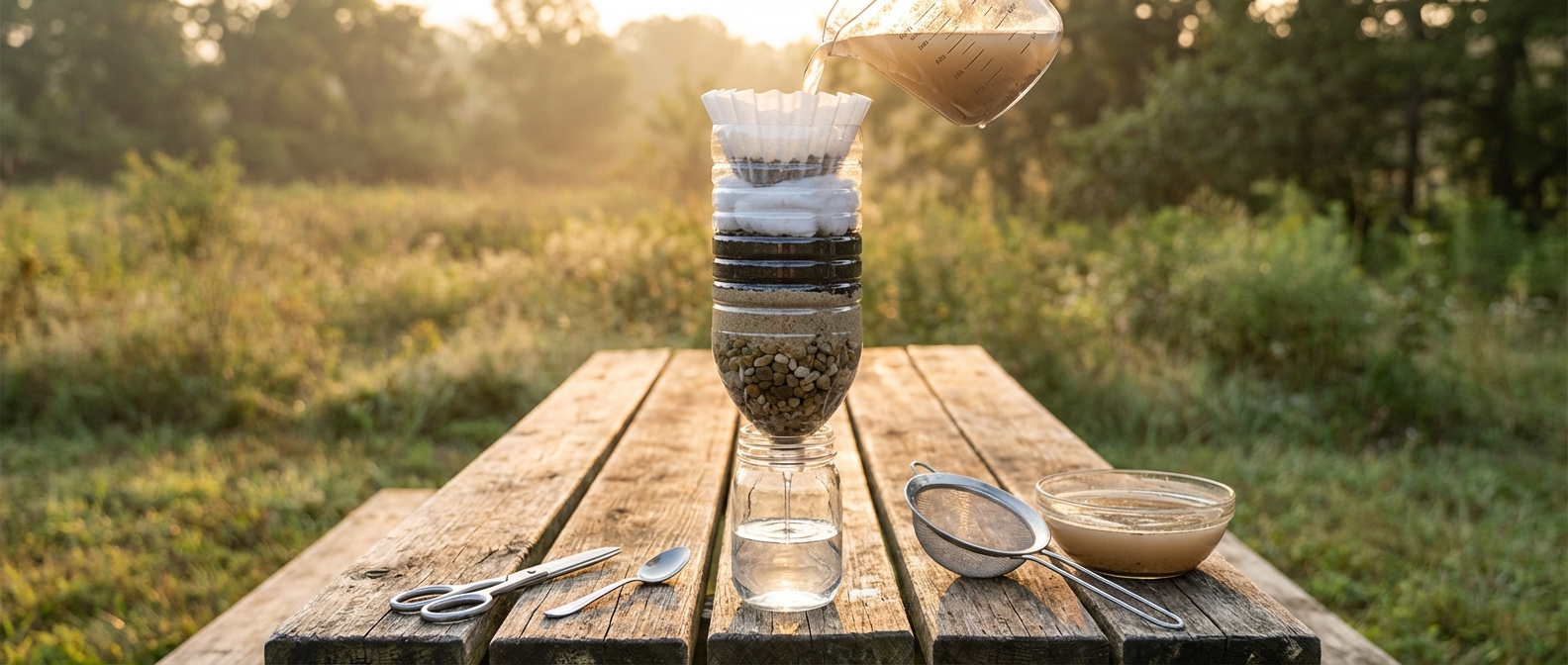
Cut the bottom off a plastic bottle, invert it, and layer cloth, crushed activated charcoal, fine sand, coarse sand (optional), and gravel. Pour water slowly so it passes through each layer, collect the output, then disinfect (boil, chemical tablets, or a certified purifier) before drinking. Use this DIY water filter only as pre-treatment. It improves clarity and reduces sediment but does not reliably make water microbiologically or chemically safe on its own.
Quick summary
This DIY water filter removes visible sediment and reduces turbidity. Activated carbon often improves taste and odor. Filter first, then disinfect by boiling, chemical tablets, a UV device, or a certified purifier.
Key definitions
- Turbidity: cloudiness caused by suspended particles such as silt, clay, and decaying plant matter. Lower turbidity lets disinfection work better.
- Activated carbon: high surface area carbon that adsorbs many organic compounds and can improve taste and odor. It does not reliably remove dissolved inorganic contaminants like heavy metals or salts.
- Adsorption: molecules sticking to a solid surface. That is how activated carbon captures some contaminants.
- Microbe size context: protozoa about 1 micrometer or larger, bacteria about 0.2 to 2 micrometers, viruses about 0.02 to 0.3 micrometers. DIY filters rarely guarantee virus removal.
What this DIY water filter does and does not do
Does
- Removes visible debris, leaves, and large particles.
- Reduces turbidity so disinfection works better.
- Improves taste and odor when you use activated carbon.
- Can trap some protozoa and larger bacteria depending on materials and packing.
Does not
- Remove viruses reliably.
- Remove many dissolved chemicals, most heavy metals, or salts.
- Replace certified treatment if industrial contamination is possible.
Pathogen and chemical removal depend on materials, packing density, and flow rate. Treat any claims of complete purification as conditional unless verified by laboratory testing.
Materials
Essential
- 1 plastic bottle (2 L works well)
- Sharp knife or scissors
- Clean cloth, coffee filter, or cotton to cover the neck
- Crushed activated charcoal (activated carbon preferred)
- Fine sand; coarse sand optional
- Small and larger gravel or pebbles
- Clean container for filtered water
- Rubber band or string
Helpful additions
- Cheesecloth or extra coffee filters for pre-filtering
- Extra bottles for staged filtration
- Bucket for pre-settling very muddy water
- Purification tablets (chlorine dioxide) or a portable UV purifier for post-treatment
Use purpose-made activated carbon when possible. Avoid charcoal contaminated with lighter fluid, paint, or chemical coatings.
Build the DIY water filter
- Cut off the bottle bottom and invert the bottle so the neck points down.
- Cover the neck with cloth or a coffee filter and secure it with a rubber band.
- Add about 2 to 4 cm (around 1 inch) crushed activated charcoal. Rinse lightly to remove dust.
- Add about 4 to 6 cm (about 1.5 to 2.5 inches) fine sand.
- Optionally add about 2 to 4 cm coarse sand.
- Add 3 to 5 cm small gravel.
- Top with larger gravel or pebbles to catch big debris and distribute flow.
Recommended order from the bottle neck upward: cloth, charcoal, fine sand, coarse sand (optional), small gravel, larger gravel.
Rinse the assembled filter by pouring relatively clean water through it several times and discard the first cloudy outputs. That clears charcoal dust and fines.
How to use it effectively
- Let very muddy water settle in a bucket for a few hours. Pour off the clearer top layer into the filter.
- Pour slowly and evenly. Fast flow disturbs the layers and reduces filtering performance.
- Discard the first cloudy output after assembly or cleaning.
- Collect filtered water in a clean container and disinfect immediately. Do not drink directly from the filter output without treatment.
Do not skip disinfection. Period.
Disinfection (perform this every time)
Boiling
- Bring water to a rolling boil for 1 minute. At elevations above about 2,000 meters (about 6,562 feet) boil for 3 minutes.
Chemical
- Use EPA- or manufacturer-recommended tablets such as chlorine dioxide, or use household bleach following CDC guidance. Follow exact dosages on the product label.
UV
- Portable UV devices can inactivate microbes, but they require clear water. Follow the device instructions exactly.
Certified purifiers
- Use devices rated for virus removal when viruses are a concern.
The DIY water filter alone does not guarantee microbiological safety.
Testing and expected performance
Expect clearer water, fewer visible particles, and better taste when activated carbon is included. Microbial reduction varies widely based on materials, packing density, and flow rate. For chemical contamination from industry or agriculture, get lab testing or use certified treatment.
If you need certainty, use test strips for basic indicators or send samples to a certified laboratory.
Safety tips and limits
- Filter first, then disinfect.
- Keep clean and dirty water areas separate to prevent cross-contamination.
- Replace filter materials when flow slows, the media look dirty, or the carbon stops improving taste.
- Do not use chemically contaminated materials such as painted bottles, treated cloth, or charcoal with additives.
- Avoid hazardous water sources, such as downstream of sewage outfalls, industrial discharge points, agricultural runoff, or floodwater near roads.
- Practice building and using this DIY water filter before an emergency.
Quick field checklist
- Choose the clearest available surface water.
- Pre-settle heavy sediment in a bucket and pour off the clearer top layer.
- Pre-filter through cloth or a coffee filter if the water is very turbid.
- Filter slowly through the DIY water filter.
- Discard the first cloudy output and disinfect immediately.
- Store treated water in a clean container.
FAQ
Q: Can a DIY water filter make river water safe to drink?
A: Not by itself. It removes sediment and improves clarity, but you must disinfect after filtering by boiling, chemical tablets, or a certified purifier.
Q: Will charcoal remove chemicals?
A: Activated carbon adsorbs many organic compounds and improves taste and odor. It is not reliable for all chemicals, heavy metals, or fuel contamination.
Q: How often should filter materials be replaced?
A: Replace materials when flow slows, the media appear dirty, or activated carbon stops improving taste.
Key takeaways
A DIY water filter is a low-cost emergency pre-treatment that improves clarity and reduces sediment. Use it as one step in a multi-barrier approach: filter to remove particles, then disinfect for microbiological safety. For chemical concerns or higher assurance, use certified treatment or laboratory testing.