Basic Orienteering for Beginners: A Prepper’s Guide to Map and Compass Navigation
Basic orienteering for beginners means learning to read a topographic map, use a baseplate compass, take and follow bearings, and confirm position using terrain and natural cues so you can navigate without GPS.
Quick overview
- Orienteering uses map, compass, and terrain awareness. No GPS required. No batteries needed.
- Start with topo map basics: contours, scale, legend, and north. Learn magnetic declination and practice taking and following bearings.
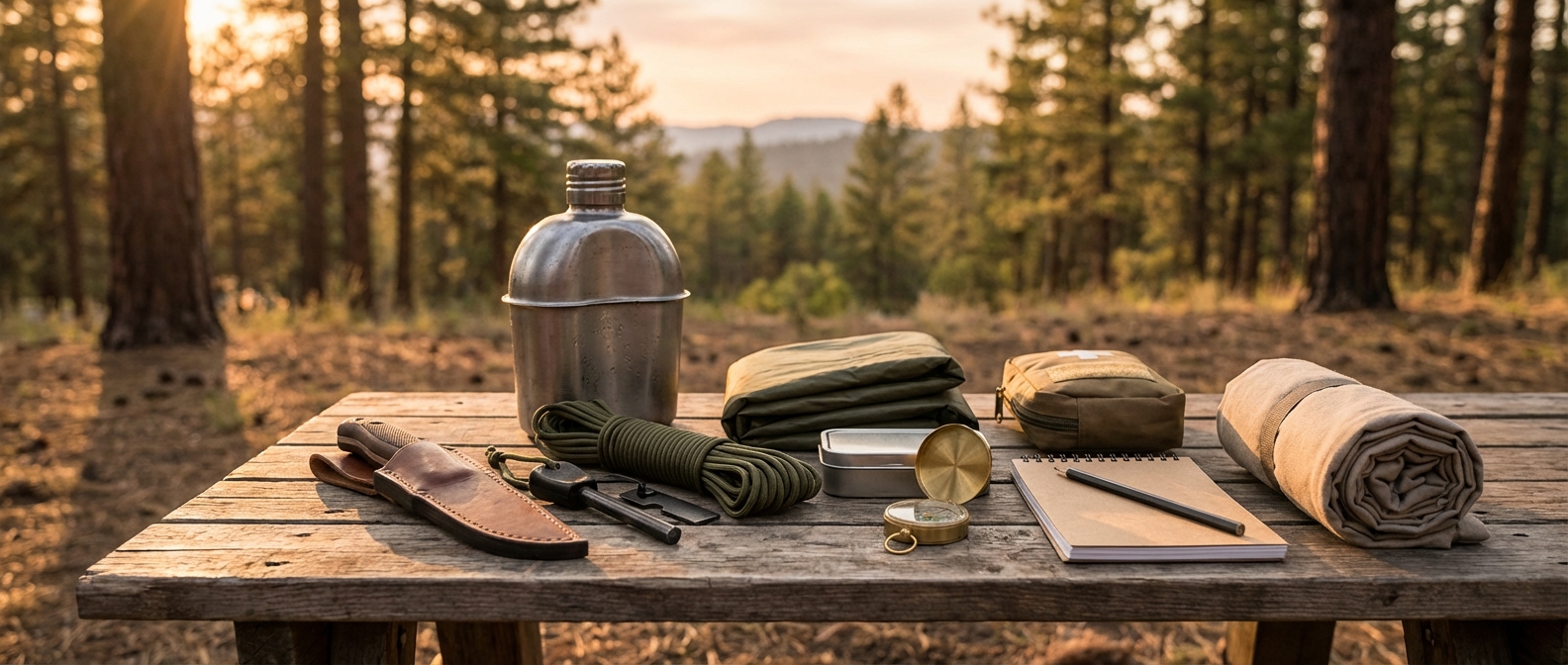
- Carry a paper topo map, a baseplate compass, a pencil, a waterproof map case, a light, a whistle, and basic first-aid.
- Practice in safe, familiar areas before relying on these skills in an emergency.
Why map-and-compass matters for preppers
Map-and-compass skills expand your options when electronics fail. You can choose safer routes, find water and shelter, and reach evacuation points without a signal. Practice reduces mistakes under stress and builds confidence.
Key reasons to learn basic orienteering for beginners:
- Batteries die and signals drop. Paper maps and compasses do not.
- A topo map shows nearby features and elevation that a single GPS point cannot.
- Terrain awareness helps you avoid cliffs, bogs, or thick brush and find safer trails or water sources.
Orienteering answers three practical questions: Where am I? Where do I need to go? What is the safest route?
Clear definitions
- Orienteering: Using a map, compass, visible terrain features, and natural cues to navigate without relying on electronics.
- Topographic (topo) map: Shows elevation with contour lines, plus water, vegetation, trails, roads, and man-made features.
- Bearing: A direction measured in degrees clockwise from north (0 or 360 = north, 90 = east).
- Magnetic declination: The angle between true north and magnetic north. It changes by location and over time.
Understanding maps: what to focus on
A topo map shows the lay of the land. Learn these elements and use them on every trip:
- Contour lines for elevation and terrain shape.
- Scale, for example 1:24,000 for detailed hiking maps.
- The legend, which explains symbols for trails, water, and structures.
- The north arrow and the declination note.
- Grid systems such as UTM or latitude/longitude for precise coordinates.
How to read contour lines (quick rules):
- Close lines indicate a steep slope. Short. Hard work.
- Widely spaced lines show a gentle slope.
- Closed contours form a hill. A marked break in the contour can indicate a depression.
- V-shaped contours that point upstream indicate a stream or valley.
Use contours to plan routes that avoid unnecessary climbs and dangerous slopes.
Orienting a paper map (simple)
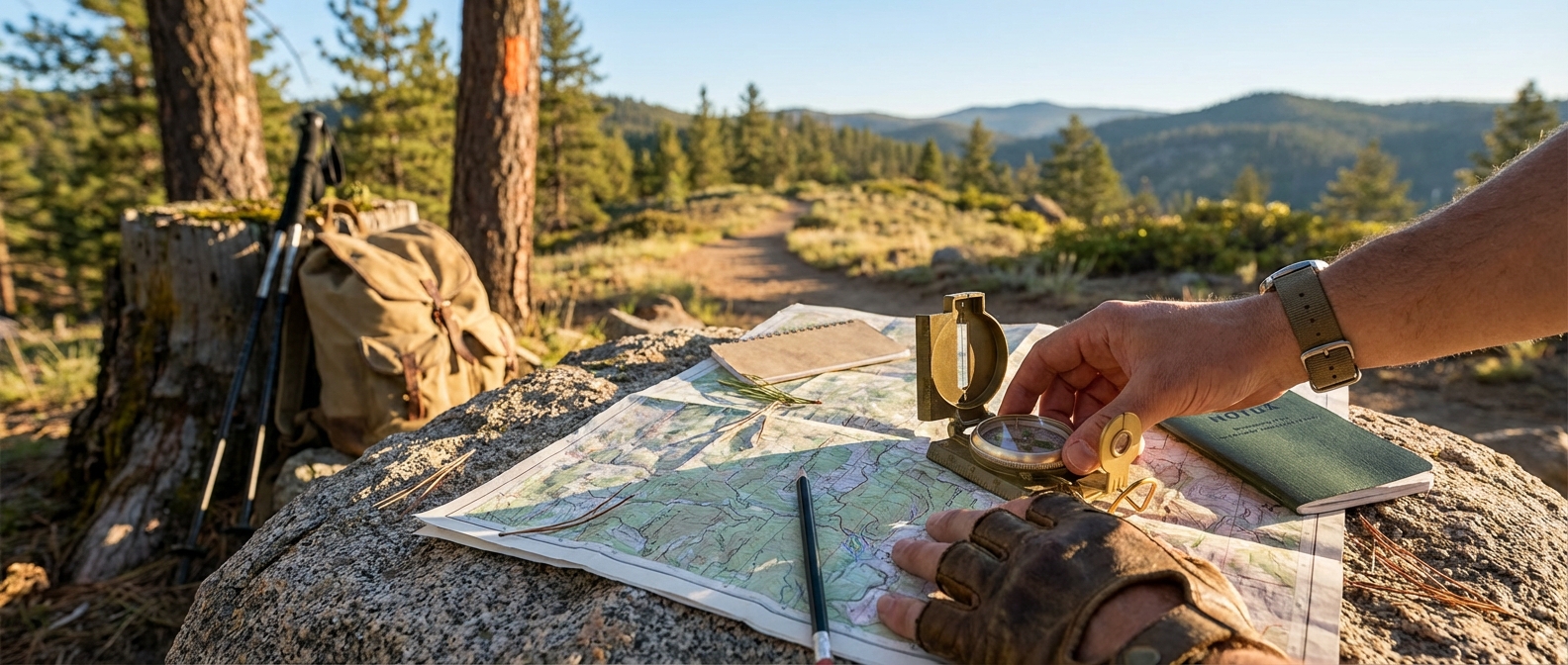
- Lay the map flat and find map north or the north arrow.
- Place your compass on the map with the edge along a northing line or between your location and destination.
- Rotate the map or your body until the compass needle aligns with the map north marks, and adjust for declination.
- Match visible terrain features such as roads, ridges, and streams to the map.
- Re-orient whenever you stop or change direction.
Practice: Stop every 10 to 15 minutes on a walk, estimate your location, then confirm it on the map.
Mastering the compass: basics and steps
Use a transparent baseplate compass with a rotating bezel and declination markings. Learn these parts: magnetic needle, baseplate, direction-of-travel arrow, rotating bezel, orienting lines, and the index line.
How to take a bearing from a map (map-to-compass):
- Lay the compass edge between your known location and the destination.
- Rotate the bezel so orienting lines point to the top of the map (true north).
- Read the bearing at the index line.
- Apply magnetic declination by adding or subtracting the local value.
How to follow a bearing in the field (compass-to-ground):
- Hold the compass level at chest height with the direction arrow pointing away from you.
- Rotate your body until the magnetic needle aligns with the orienting arrow in the bezel.
- Pick a visible landmark on that line and walk to it.
- Repeat until you reach the target.
National agencies such as NOAA publish local magnetic declination values and provide online calculators.
Beginner compass drills
- Cardinal practice: find north, east, south, and west until it becomes automatic.
- Walk-a-bearing: hold a fixed bearing for 50 to 100 meters and check accuracy.
- Map-to-ground match: choose a map feature, take a bearing, then find it in the field.
- Box navigation: use four bearings and pace counts to return to the start.
Navigation without tech: natural and terrain cues
Combine map, compass, and natural cues when possible.
- Sun: It rises generally in the east and sets generally in the west. Around midday, the sun is roughly south in the Northern Hemisphere.
- Stars: Use Polaris to find north in the Northern Hemisphere.
- Terrain association: Confirm ridges, valleys, streams, lakes, and roads against your map.
- Navigation features: use handrails (linear features such as a trail or river), backstops (a ridge or lake that stops forward movement), and attack points (distinct nearby landmarks) to locate goals.
Ask yourself often while moving:
- What did I just pass?
- What should I see next?
- Is my current direction consistent with the map?
Common mistakes and how to avoid them
- Not orienting the map each time. Orient the map whenever you stop.
- Ignoring declination. Learn the local value and apply it.
- Checking position too infrequently. Confirm at regular intervals and at key features.
- Walking while staring at the compass. Take a bearing, pick a landmark, then walk.
- Relying on one method. Combine map, compass, terrain, and natural cues.
- Not practicing. Start local and build skill.
- Failing to plan. Pre-identify checkpoints, hazards, and water sources.
Practical gear checklist (minimum)
- Paper local topographic map
- Reliable baseplate compass
- Pencil and small notebook
- Waterproof or protective map case
- Backup light and whistle
- Basic first-aid items and weather layers
Recommended resources: USGS topo maps or your national mapping agency, official declination tools, local navigation courses, and reputable field guides.
One-week practice plan for beginners
- Day 1: Study a local topo map for 30 minutes. Identify a 1 to 2 mile route.
- Day 2: Learn compass parts and practice cardinal points at home.
- Day 3: Walk the route with the map in hand. Stop every 10 minutes and identify your location.
- Day 4: Practice taking and following two to three bearings of 100 to 200 meters.
- Day 5: Night or sky navigation. Learn to locate Polaris if you are in the Northern Hemisphere.
- Day 6: Box navigation and pace-count practice.
- Day 7: Review mistakes, repeat weak skills, and pack the minimum gear for a longer outing.
FAQ: basic orienteering for beginners
Q: What is orienteering in simple terms? A: Finding your way using a map, compass, terrain, and natural signs instead of depending only on electronics.
Q: Why learn these skills? A: They let you move safely and confidently if GPS or phones fail.
Q: How do I read a topographic map? A: Learn the legend, scale, north orientation, and contour lines. Contours show elevation and terrain shape.
Q: What is the easiest way to use a compass? A: Start with cardinal directions. Practice simple bearings. Keep the compass level, align the needle with the orienting arrow, then walk to a landmark.
Q: Can I navigate without GPS? A: Yes. Paper maps, compasses, landmarks, and natural cues are reliable, especially in remote areas.
Q: What should a beginner carry for orienteering? A: Topo map, baseplate compass, pencil, map case, backup light, whistle, and basic first-aid.
Build skill. Start small.
Practice short sessions in familiar terrain. Build muscle memory for map orientation and compass use. Add one natural navigation method at a time, such as sun position or Polaris. Take a field navigation course when you can and check local search-and-rescue or outdoor-safety organizations for region-specific training and data.