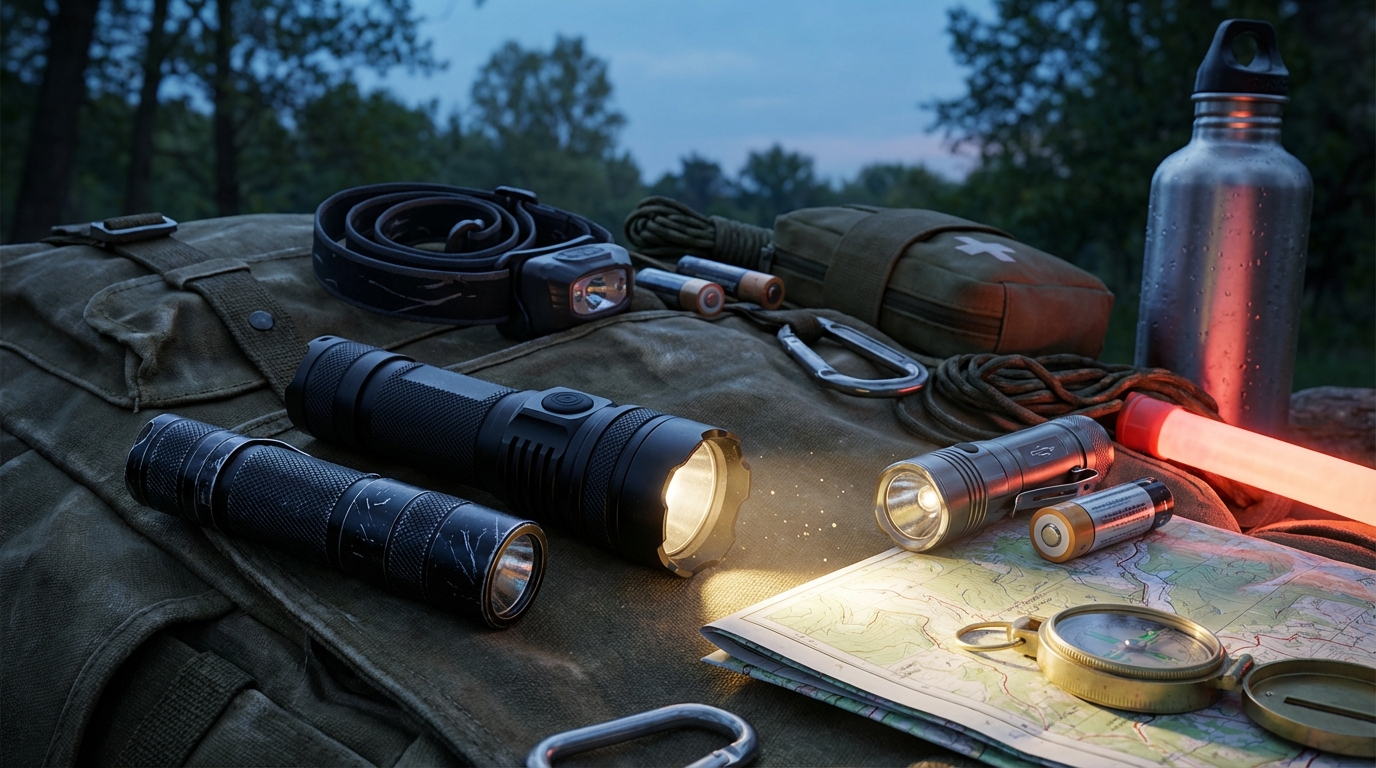
Best Survival Flashlights: Top Picks for Your Emergency Kit
Quick answer
- The best survival flashlights are rugged LED lights with at least 200 lumens, a long low-mode runtime, and water resistance rated IPX7 or higher.
- Recommended kit: one rechargeable handheld (USB-C with 18650 or 21700), one hands-free headlamp, and one inexpensive AA/AAA or CR123A backup.
Core criteria
- Lumens: total visible output. More lumens increase brightness and usually reduce runtime.
- Candela / Beam distance: measures intensity in one direction. Choose a light with throw if you need to scan long distances.
- Runtime: check runtime on the low mode you expect to use. That will determine how long the light lasts during outages.
- IP ratings: IPX7 and IP68 indicate immersion and dust resistance. Read the manufacturer’s test conditions.
- Battery types: AA/AAA are easy to find. CR123A are compact disposable cells. 18650 and 21700 are high-capacity rechargeables. USB-C recharging simplifies field top-ups.
Why a flashlight belongs near the top of your prep list
A dependable light lets you navigate in darkness, perform repairs, read maps, treat injuries, and signal for help. It prevents trips and falls. It helps with search and communication. Small lights deliver high utility for little weight.
Key features for the best survival flashlights
Required
- Brightness: at least 200 lumens for useful tasks. Between 300 and 1000 lumens covers most needs.
- Runtime: prioritize long low-mode runtime, typically 10 to 50+ hours.
- Water resistance: IPX7 or better.
- Durability: metal or reinforced polymer bodies, tight seals, and reliable switches.
Recommended
- Power mix: a rechargeable primary (18650 or 21700) plus disposable backups (AA or CR123A).
- Simple controls: single-button or clear mode cycles you can operate under stress.
Useful extras
- USB-C charging, tail-stand capability, pocket clip, and a dedicated SOS or strobe mode.
Notes
- Manufacturer runtime and IP claims vary. Verify model-specific specs and recent real-world reviews.
- Brand names and LED chip types give clues, but test results and user reports reveal true performance.
Brightness and beam types
- Flood beam: wide, even light for close work, campsites, and indoor use.
- Throw beam: focused, far-reaching beam for scanning or signaling.
- Adjustable or balanced beams combine close work and throw. Use a balanced handheld as your primary and a headlamp for close tasks.
Batteries and charging — practical rules
- Use a rechargeable handheld as your primary source. 18650 or 21700 cells with USB-C recharge well in the field.
- Carry one or two disposable backups in AA, AAA, or CR123A formats for extended outages. Bring spares.
- Store spare batteries in a cool, dry place. Remove batteries if you plan long-term storage without rotation.
Manufacturer runtime figures reflect specific modes. Focus on low-mode runtime for outages.
Maintenance and storage
- Test lights monthly or quarterly to make sure switches and modes work.
- Keep a small maintenance kit: spare O-rings, contact cleaner, a small screwdriver, and an extra USB cable.
- Replace cracked O-rings and apply light silicone grease only if the manufacturer recommends it.
Top picks for the best survival flashlights
Starter recommendations focus on durability, usable features, and broad availability. Confirm current specs before buying.
- Fenix PD36R Pro — primary handheld with high output, USB-C charging, and a rugged build.
- Streamlight ProTac 2L-X — compact, durable, available in dual-fuel configurations.
- Coast PX22 — affordable backup suitable for multiple kits.
- SureFire G2X Pro — rugged, simple, field-proven; works well with disposables.
- Energizer Hard Case Professional LED — widely available AA option for family preparedness.
- Black Diamond Spot 400-R (headlamp) — rechargeable hands-free light for repairs and first aid.
Model names and specs change. Check vendor pages for the latest details.
Quick comparison
| Model | Type | Typical Output (lumens) | Typical Power | Water Rating | Best Use |
|---|---|---|---|---|---|
| Fenix PD36R Pro | Handheld | 200–2000+ | USB-C / 18650 or 21700 | IP68 (model dependent) | Primary survival light |
| Streamlight ProTac 2L-X | Handheld | 200–1000+ | Dual-fuel / rechargeable | IPX7 (model dependent) | Compact all-rounder |
| Coast PX22 | Handheld | ~100–400 | AA/AAA | Varies | Budget backup |
| SureFire G2X Pro | Handheld | ~200–600 | Disposable (CR123A / AA) | Weather resistant | Rugged simplicity |
| Energizer Hard Case | Handheld | ~100–400 | AA | Varies | Family preparedness |
| Black Diamond Spot 400-R | Headlamp | ~200–400 | Rechargeable | Weather resistant | Hands-free tasks |
Values are ranges. Check each model for exact outputs and runtimes.
Recommended kit for most new preppers
- Primary: rechargeable handheld with USB-C, 18650 or 21700 cells, at least 200 lumens, and strong low-mode runtime.
- Hands-free: headlamp, rechargeable or AA, for close work and first aid.
- Backup: inexpensive AA/AAA or CR123A light for the car, kitchen, or glovebox.
- Power spares: four to eight spare disposable cells plus a small power bank or compact solar charger.
Short FAQ
Q: How bright should a survival flashlight be?
A: Minimum 200 lumens for useful tasks. Between 300 and 1000 lumens works for most situations.
Q: Rechargeable or disposable?
A: Both. Use rechargeable lights as your primary source. Keep disposables as a reliable fallback.
Q: What water rating do you need?
A: IPX7 or better. Verify the manufacturer’s test conditions for the model you choose.
Q: How long should runtime be?
A: Prioritize long low-mode runtime, typically 10 to 50+ hours depending on the light.
Next steps
- Choose a primary handheld with at least 200 lumens and dependable low-mode runtime. Prefer USB-C if you can recharge reliably.
- Add a headlamp for hands-free tasks.
- Keep at least one disposable-powered backup and several spare batteries.
- Test and maintain your lights regularly.
Notes
- Verify IP ratings and exact test conditions with the manufacturer.
- Confirm runtime at the brightness levels you expect to use and read recent user reviews for real-world reliability.