DIY Survival Gear: Essential Projects & Tools for Beginners
TL;DR: DIY survival gear projects are simple, low-cost builds you can make at home to learn skills, fill gaps in store-bought kits, and provide short-term emergency function. Start with fire starters, a bottle pre-filter (not a purifier), paracord cordage, a tin candle or alcohol stove for advanced practice, and a compact first-aid organizer. Test everything and use certified products for life-critical tasks.
If your emergency plan is “panic creatively,” upgrade it with focused, beginner-friendly DIY survival gear projects, clear definitions, a prioritized quick-start list, concise build steps, and plain safety guidance.
Quick definitions
- DIY survival gear: Homemade or improvised tools for short-term emergency needs like fire, water handling, first aid, shelter, and light. Good for learning and redundancy but not always a substitute for certified equipment.
- Pre-filter: Removes sediment and debris but does NOT make water microbiologically safe. Always follow with purification such as boiling, chemical tablets, or a certified filter.
- Certified purifier/filter: Products tested to remove bacteria, protozoa, and viruses (examples: LifeStraw, Sawyer, MSR).
- Paracord: Lightweight nylon rope (often 550 cord) with inner strands used for repairs, shelter, and gear.
- Solar still: Slow, low-yield method to collect condensed water. Useful as a backup or learning project.
Quick-start projects (prioritized)
Start with these. They cost little, teach core skills, and are easy to test.
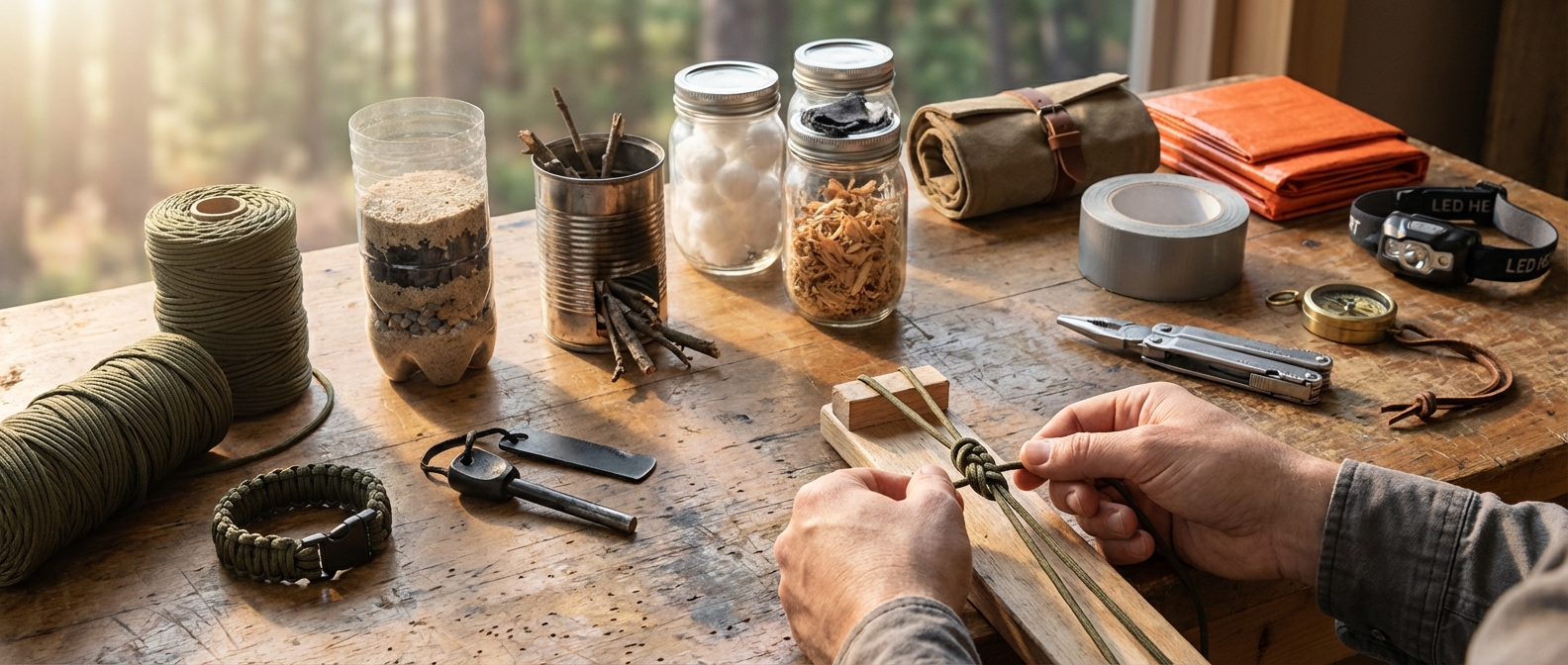
- Cotton + petroleum-jelly fire starters
- Difficulty: Easy, Time: 10-30 min, Use: reliable ignition
- Materials: cotton balls, petroleum jelly, waterproof container
- Bottle water pre-filter (NOT a purifier)
- Difficulty: Easy to moderate, Time: 30-60 min, Use: remove debris before purifying
- Materials: plastic bottle, cloth or coffee filter, activated charcoal, sand, gravel
- Paracord bracelet or lanyard
- Difficulty: Easy, Time: 15-45 min, Use: compact emergency cordage
- Materials: paracord (550), buckle or key ring, lighter
- Tin candle
- Difficulty: Easy, Time: 30-60 min, Use: light and small heat source
- Materials: metal tin, wick, wax
- Compact first-aid organizer
- Difficulty: Easy, Time: 20-60 min, Use: immediate wound care
- Materials: zip pouches, gauze, bandages, tape, antiseptic wipes
Mini alcohol stoves are useful but advanced; practice proper safety. Solar stills are slow. Use them as a backup.
Why DIY survival gear matters
- You learn by doing. Building gear shows how equipment works and how to repair or maintain it.
- DIY lets you tailor items to local climate and household needs, often at lower cost.
- Follow FEMA and the American Red Cross recommendations for a disaster supply kit and know how to use your gear.
Limitations: DIY is great for skills and redundancy. Do not rely on homemade solutions for critical medical care or guaranteed pathogen removal. Use tested products and training for life-critical tasks.
Materials & tools (compact list)
- Consumables: cotton balls, petroleum jelly, wax, dryer lint
- Filtration: plastic bottles, coffee filters or cloth, activated charcoal, sand, gravel
- Cordage & hardware: paracord, buckles, key rings
- Containers: metal tins, resealable bags, durable storage boxes
- Tools: scissors, utility knife, multi-tool, lighter, double-boiler or heat-safe vessel
- Medical basics: bandages, sterile gauze, antiseptic wipes, tape, tweezers, gloves
When water safety is required, use certified purifiers or CDC-recommended boiling and chemical methods.
Step-by-step builds (test before use)
Practice builds in a safe, controlled environment before relying on them.
Cotton & petroleum-jelly fire starters
- Materials: cotton balls, petroleum jelly, waterproof container
- Steps:
- Stretch a cotton ball to expose fibers.
- Work petroleum jelly into the fibers until saturated.
- Store in a waterproof container. Test outdoors by igniting the exposed tip.
Egg-carton wax fire starters
- Materials: cardboard egg carton, dryer lint or sawdust, wax
- Steps:
- Fill egg cups with lint or sawdust.
- Melt wax safely using a double-boiler and pour into cups.
- Let cool, cut pods, and store dry.
Bottle pre-filter (NOT a purifier)
- Materials: disposable plastic bottle, cloth or coffee filter, activated charcoal, sand, gravel
- Steps:
- Cut the bottle and invert the top into the bottom section.
- Line the neck with a cloth or coffee filter.
- Layer activated charcoal, then sand, then gravel.
- Pour slowly and collect the filtered water. Always purify after filtering.
Warning: This improves clarity and protects downstream filters but does not make water safe to drink by itself.
Paracord bracelet or lanyard
- Materials: paracord (550), buckle or key ring, lighter
- Steps:
- Measure and cut cord with extra length.
- Attach to the buckle or key ring and weave using a cobra or similar weave.
- Trim and melt ends to prevent fraying.
Tin candle
- Materials: small metal tin, wick, wax
- Steps:
- Secure the wick in the center with a dab of melted wax.
- Melt wax safely and pour into the tin, holding the wick upright.
- Cool fully and cap to keep dry.
Mini alcohol stove (advanced)
- Materials: two aluminum cans, a tool for jets, denatured alcohol
- Notes:
- This is an advanced build with fire and vapor risks. Practice outdoors on a stable, non-flammable surface.
- Never add fuel to a lit stove. Keep an extinguisher or water nearby.
First-aid kit organizer
- Materials: zip pouches, labels, essential medical supplies
- Steps:
- Sort supplies by category: wound care, tools, medications.
- Label pouches and include an emergency card with contacts and allergies.
- Check expiration dates every 6 to 12 months.
Safety tips & common mistakes
Safety tips:
- Use DIY filters only as pre-filters. Purify water with CDC methods or certified filters.
- Use heat and open flames outdoors or in well-ventilated areas. Keep extinguishing materials close.
- Wear gloves and eye protection when cutting, melting, or handling chemicals.
- Test gear. Practice the scenarios you expect to face.
Common mistakes:
- Building gear but never practicing with it.
- Starting complex projects before mastering the basics.
- Assuming DIY equals certified performance for life-critical tasks.
- Failing to customize kits for local risks such as flood, wildfire, or winter weather.
FAQ
Q: What should beginners make first? A: Fire starters, a bottle pre-filter (and learn purification), a paracord lanyard, a tin candle, and a compact first-aid organizer.
Q: Are DIY projects cost-effective? A: Yes for non-critical items and skill-building. For critical functions, certified gear is usually worth the cost.
Q: Is DIY survival gear enough on its own? A: No. DIY complements purchased, tested equipment, training, and a broader emergency plan.
Get started
Pick one small DIY survival gear project this week. Build it. Test it safely. Add more projects as your skills grow. Focus on practical experience and redundancy, not just collecting items.
For authoritative checklists and water-treatment instructions, consult FEMA, the American Red Cross, and the CDC.
Affiliate note: This article may reference products in affiliate categories such as paracord, fire-starting supplies, water filters, and first-aid components. The author may earn a commission at no extra cost to you.