Survival Fishing Tips: A Beginner’s Guide to Catching Dinner
Quick answer
A tiny kit (6-12 lb line, assorted hooks, a few weights, swivels, and a knife or pliers), basic knots (Palomar, improved clinch), and targeting structure like weed edges, drop-offs, and current breaks will let you catch fish with low-tech methods such as a hand line, a makeshift pole, or simple traps. Practice your skills, check local laws and contamination advisories, and include fishing in a broader emergency plan.
Summary
This is a practical set of survival fishing tips for beginners: what minimal gear to carry, where to find fish, low-tech methods that work without a modern rod, essential knots, and basic cleaning and preservation. Build a tiny kit now and practice the Palomar and improved clinch knots with a hand line or a makeshift pole.
Verify facts and advisories
- Check FAO and WHO sources if you need statistics on global fish protein. Verify any broad claims against current data.
- Check local fish advisories for mercury, PCBs, and other contaminants before you eat wild fish.
Key definitions
- Survival fishing: low-resource methods and minimal gear to get food in emergencies or in the backcountry.
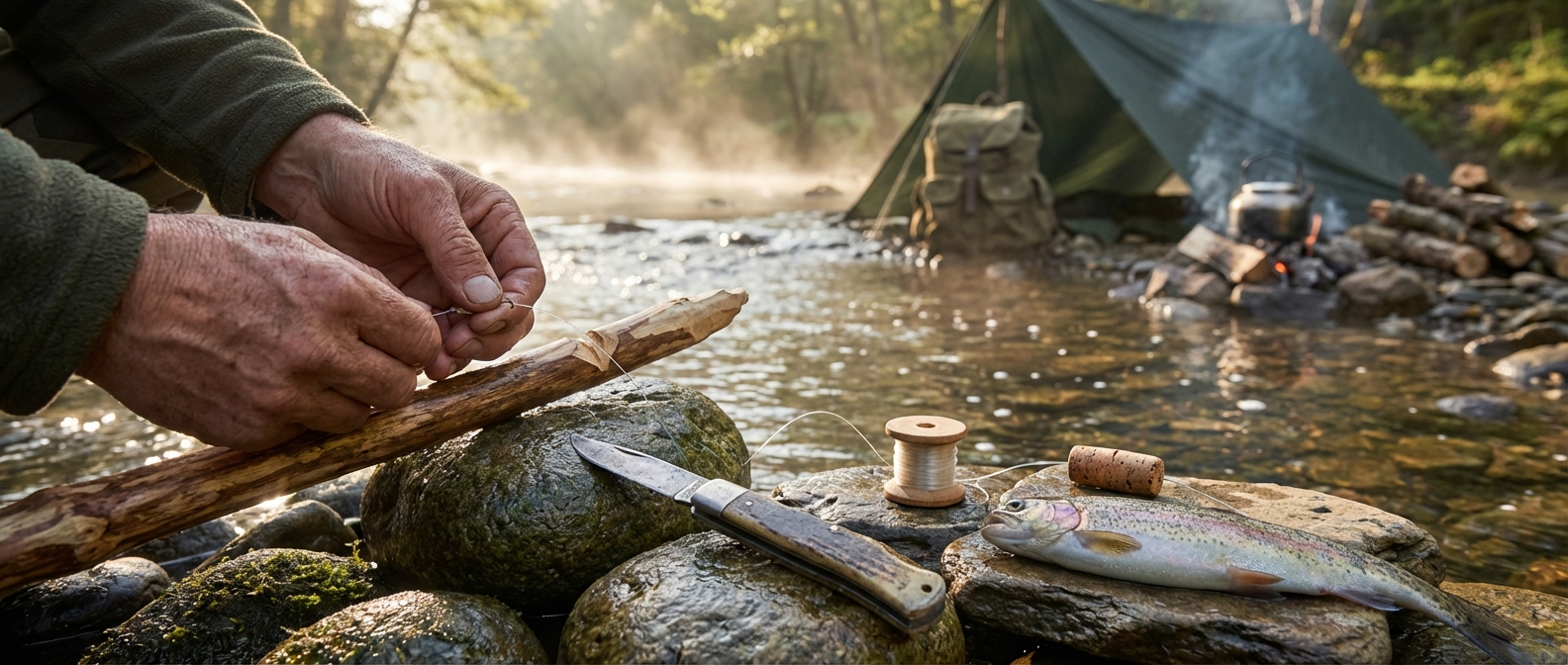
- Hand line: line wound on a stick or spool, no rod required.
- Makeshift pole: a flexible branch used like a fishing rod.
- Setline or trotline: a stationary line with multiple hooks; legality varies by place.
- Fish trap or weir: passive funnels or rock structures that guide fish into a catch area.
Quick start: survival fishing tips for beginners
What to carry (minimal kit):
- 6-12 lb monofilament line (lighter for panfish; heavier for big river fish)
- Assorted hooks (#8-2), include circle or baitholder types
- Split-shot weights and a couple heavier sinkers
- Several swivels and short leaders
- Small knife and pliers or a multitool
- Small waterproof container for tackle
Top priorities:
- Target structure: weed edges, drop-offs, logs, current breaks
- Use low-tech methods: hand line, makeshift pole, simple traps
- Practice knots: Palomar, improved clinch, uni
- Check local regulations and contamination advisories before harvesting
Essential gear: compact and multipurpose
Must-have items:
- 6-12 lb monofilament spool
- Hooks in multiple sizes
- Split-shot and a couple heavier sinkers
- Swivels and short leaders
- Knife or fillet knife and pliers or multitool
- Small spool or hand reel and a simple float
Smart additions if you have space:
- Small landing net or a durable glove
- A couple soft plastics, a jig, or a spinner
- Extra leader material and a heavier backup line
- Headlamp for dawn and dusk
- Waterproof bag for tackle, plus matches or a lighter
Knots and line care
- Learn and practice: Palomar, improved clinch, uni. Repeat until your hands remember.
- Inspect the line regularly. Replace it if it is nicked or damaged by UV.
- Store line wound and out of direct sunlight.
Finding fish: where to look
Rivers and streams:
- Current breaks behind rocks and logs
- Deep pools below riffles
- Undercut banks and eddies
- Confluences where tributaries join the main channel
Lakes and ponds:
- Fallen trees and submerged structure
- Weed edges and drop-offs
- Points, shady shorelines, inlet and outlet areas
Signs of fish activity:
- Insect hatches, schools of baitfish, diving birds, surface rises
Low-tech techniques that work
Hand line (simple steps):
- Wrap line on a stick or spool and tie on a hook and weight.
- Bait with worms, insects, or small baitfish.
- Lower into likely spots, feel for a bite, and set the hook with a firm pull.
Makeshift pole (shore use):
- Choose a 6-10 ft flexible sapling or branch.
- Tie the line to the tip, add hook and weight, and present bait to likely spots.
- Use from shore or a stable bank. This works best in calm water.
Traps and weirs:
- Bottle funnel traps, reed or wicker traps, and rock weirs catch fish passively.
- Place them in narrow channels or along known travel routes.
- Follow local laws and harvest sustainably.
Setlines and trotlines:
- Efficient where legal. Check lines often to reduce bycatch and to minimize fish stress.
Spearing and hand-fishing:
- These methods require skill and knowledge of local law. Be aware of safety risks and restrictions.
- When spearing, aim lower than the apparent target to compensate for light refraction in water.
Species, bait, and local considerations
Common freshwater targets:
- Panfish such as bluegill and sunfish, bass, trout, catfish, carp, and minnows
Natural bait options:
- Earthworms and nightcrawlers, grubs, grasshoppers, crickets
- Small baitfish when allowed, and shrimp or eggs in coastal areas
Local considerations:
- Check consumption advisories and protected species lists.
- Match bait and technique to the common species in your region.
Safety, conservation, and legal notes
- Check local regulations and licensing before fishing outside declared emergencies.
- Respect bag and size limits and practice selective harvesting.
- Avoid fishing in contaminated waters. Follow public health advisories.
- Wear a life jacket when wading above knee-deep water or when boating.
- Be mindful of dangerous wildlife such as bears, alligators, and venomous snakes. Dispose of scraps away from camp.
When to avoid fishing:
- Fast, unstable water or high flows
- Thunderstorms or severe weather
- Known contamination advisories
Cleaning, cooking, and preserving your catch
Basic field cleaning:
- Dispatch humanely.
- Scale if needed, cut from the vent toward the head, and remove the entrails.
- Rinse with clean water if available. If not, wipe and cook thoroughly.
Simple cooking methods:
- Roast on a stick over coals.
- Pan-fry in a mess kit.
- Boil for stew or wrap in leaves and bake near embers.
Preservation options:
- Cold storage when available.
- Smoke, dry, or salt-cure to extend shelf life.
FAQ: practical survival fishing tips
Q: What is the smallest kit I can carry?
A: 6-12 lb line, assorted hooks, a few split-shot, swivels, a knife, and a small waterproof container.
Q: How often should I practice?
A: At least once a year. Practice knot-tying, species ID, bait selection, and cleaning and cooking until the routine is smooth.
Q: Can I rely on fish as my only food source?
A: Fish can provide a reliable supplement, but not a guaranteed sole food source. Availability depends on season, location, and skill.
Quick checklist to build now
- 6-12 lb monofilament spool
- Hook assortment (#8-2)
- Split-shot and a few heavier sinkers
- Several swivels and short leaders
- Small knife and pliers or multitool
- Small waterproof container
- Basic first-aid kit and a life jacket if you will boat or wade
Put these survival fishing tips to use
Survival fishing is a high-value skill. Compact gear, careful reading of water, and low-tech techniques can produce food in many environments. Practice legally and safely, check local advisories before eating anything you catch, and include fishing along with other emergency food plans.
Next steps
- Build the compact kit listed above.
- Practice knots and hand-line or makeshift-pole fishing on a legal outing.
- Verify regional consumption advisories and local fishing regulations.
Related articles:
- Becoming a Prepper: The Beginner’s Guide to Survival Readiness
- How to Build a Bug Out Bag: Essentials for a Quick Getaway
- Water, Water Everywhere: How to Store H2O Without Losing Your Sanity