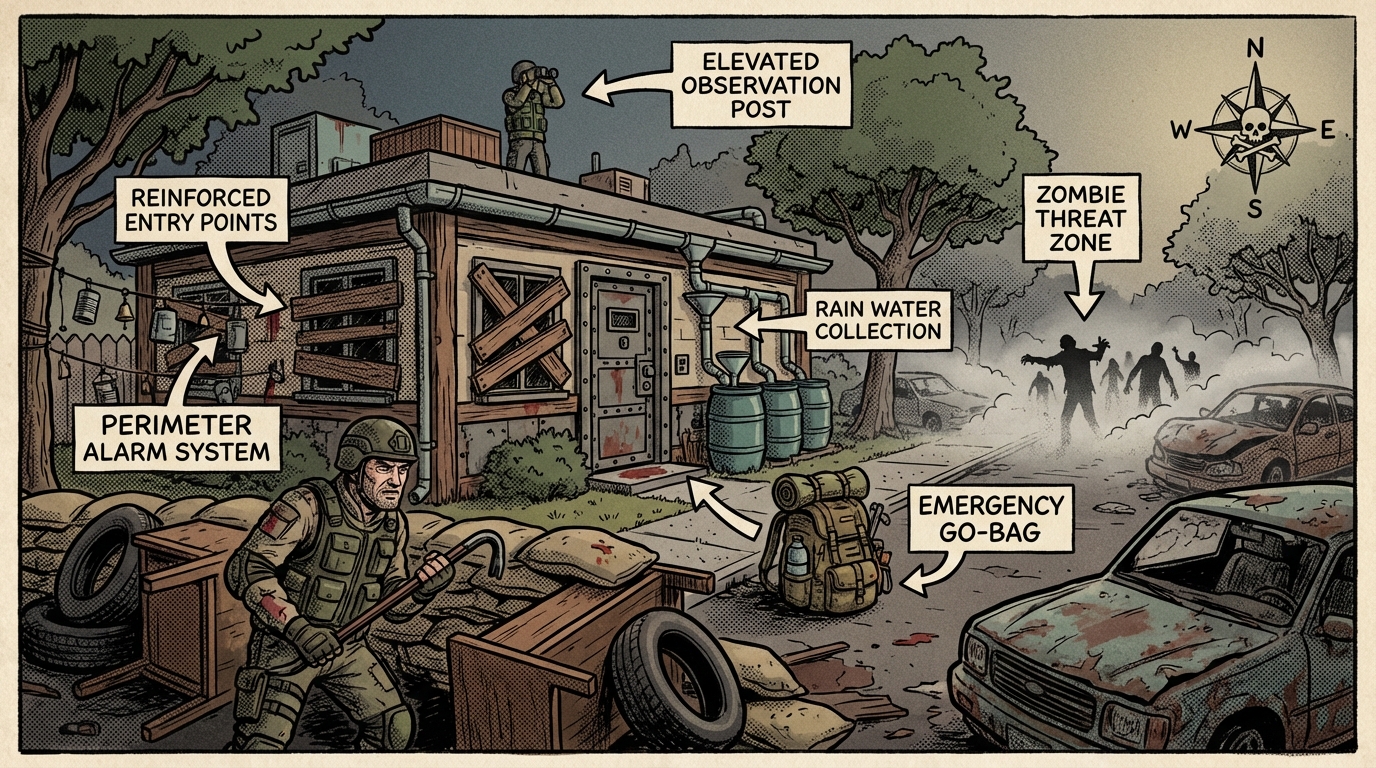
I’m going to be straight with you: I don’t believe in zombies. But after 12 years as a FEMA-trained emergency management professional and Wilderness First Responder in the Pacific Northwest, I can tell you that zombie apocalypse survival preparedness is one of the most effective frameworks ever created for teaching people how to actually survive real disasters. I deployed with a Type 3 incident management team during the 2020 Oregon wildfire crisis where over 500,000 acres burned and 40,000 people evacuated — every lesson in this guide comes from situations like that.
The best way to prepare for a zombie apocalypse is to follow proven disaster preparedness steps used by the CDC and FEMA:
- Build a 72-hour emergency kit
- Store one gallon of water per person per day
- Plan three evacuation routes from your home
- Create a family communication plan with an out-of-area contact
- Learn trauma first aid through a Stop the Bleed course
- Fortify your home entry points against forced intrusion
- Build community with prepared neighbors and allies
- Practice your complete plan under realistic conditions twice a year
Pandemics, cascading infrastructure failures, massive earthquakes, wildfire evacuations — I’ve responded to versions of all of these in the field. Every single one required the same core competencies that zombie preparedness teaches. So let’s use the most entertaining disaster scenario ever imagined to build you a survival plan that works against threats that are very, very real.
Quick Summary
- The zombie framework is a real preparedness tool — used by the CDC, referenced by the DoD (CONPLAN 8888), and endorsed by emergency management professors
- Your first 72 hours determine everything — build a kit, know your routes, and have a communication plan before disaster strikes
- Water is your #1 priority, not weapons — dehydration kills faster than any threat you’ll face
- Fortify your shelter against all threats, including desperate humans — this is the most overlooked step in any disaster plan
- Location matters less than preparation — rural areas aren’t automatically safe, and urban areas aren’t automatic death traps
- Long-term survival requires community, not lone-wolf tactics — every experienced responder knows this
What the CDC and DoD Actually Say About Zombie Preparedness
Before we dig into tactics, let’s talk about why this isn’t fringe. The zombie preparedness concept has been institutionally endorsed at the highest levels of government — and understanding that history matters for understanding why this framework works.
In May 2011, the CDC’s Assistant Surgeon General Ali Khan published a blog post titled “Preparedness 101: Zombie Apocalypse.” The idea was simple: repackage standard disaster preparedness advice — water storage, emergency kits, evacuation planning — inside a zombie narrative to capture public attention. It worked beyond anyone’s expectations. The post generated so much traffic that it crashed CDC servers for the first time in the agency’s history. The CDC followed up with a full graphic novel, Preparedness 101: Zombie Pandemic, which became one of their most-downloaded publications ever.
But the CDC wasn’t alone. In 2011, the U.S. Department of Defense produced CONPLAN 8888, officially titled “Counter-Zombie Dominance.” This wasn’t a joke — it was an unclassified strategic planning exercise created by military students at U.S. Strategic Command. The brilliance of using zombies as the threat scenario was twofold: it taught real operational planning skills (resource allocation, population protection, supply chain management), and because zombies aren’t a real political entity, the document couldn’t be mistaken for an actual war plan against any nation. The training value was real even though the enemy was fictional.
The American Red Cross also got in on it, producing a zombie apocalypse activity guide designed for youth groups and community organizations. Their logic was the same — the zombie wrapper makes people engage with emergency preparedness content they’d otherwise ignore.
The CDC, Department of Defense, and Red Cross all independently concluded the same thing: zombie scenarios teach real survival skills better than traditional outreach. That should tell you something.
I use this same approach in my community preparedness workshops. The moment I say “zombie scenario,” people lean forward. When I say “Cascadia Subduction Zone earthquake preparedness,” half the room checks their phone. But the plans we build are identical.
The beauty of preparing for a zombie apocalypse is that it forces you to plan for the absolute worst case: no power grid, no emergency services, no supply chain, hostile threats everywhere, and an indefinite timeline. If you can survive that, you can survive anything.
10 Rules to Survive a Zombie Apocalypse (That Apply to Any Disaster)
Before we get into detailed planning, here are the ten rules I’ve distilled from over a decade of real-world emergency response. Memorize these. They’ll save your life whether the threat shambles or drives a pickup truck.
1. Water before weapons. Dehydration kills faster than any threat. Secure your water supply before you think about anything else.
2. Build your 72-hour kit before anything else. Having a grab bag ready means you can evacuate in 60 seconds. Everything else is built on top of this foundation.
3. Know three ways out of your neighborhood. Primary road, secondary road, and a foot or bike path that bypasses traffic entirely. Drive or walk each one before you need them.
4. Fitness is a survival skill. If you can’t hike five miles with a loaded pack, fix that now. Every disaster demands sustained physical exertion.
5. Fortify your home now — not after disaster strikes. A $30 door reinforcement kit installed on a calm Saturday is worth more than a $3,000 security system you can’t get delivered during a crisis.
6. Learn trauma first aid. Take a free Stop the Bleed course and learn hemorrhage control. It’s the single most impactful medical skill a civilian can have.
7. Establish a communication plan with an out-of-area contact. When local cell networks jam, a single relay contact 500+ miles away becomes your family’s communication hub.
8. Build community — lone wolves die first. Organized groups of 15–50 people with diverse skills outlast individuals in every long-term scenario, historical or simulated.
9. Practice your plan under realistic conditions twice a year. Run your evacuation route. Set up your shelter. Start a fire in the rain. Plans that haven’t been tested are just wish lists.
10. Start today — imperfect action beats perfect planning. A half-packed go bag by your door tonight is infinitely more useful than the perfect survival kit you’ll build “someday.”
Step 1: Build Your 72-Hour Emergency Kit
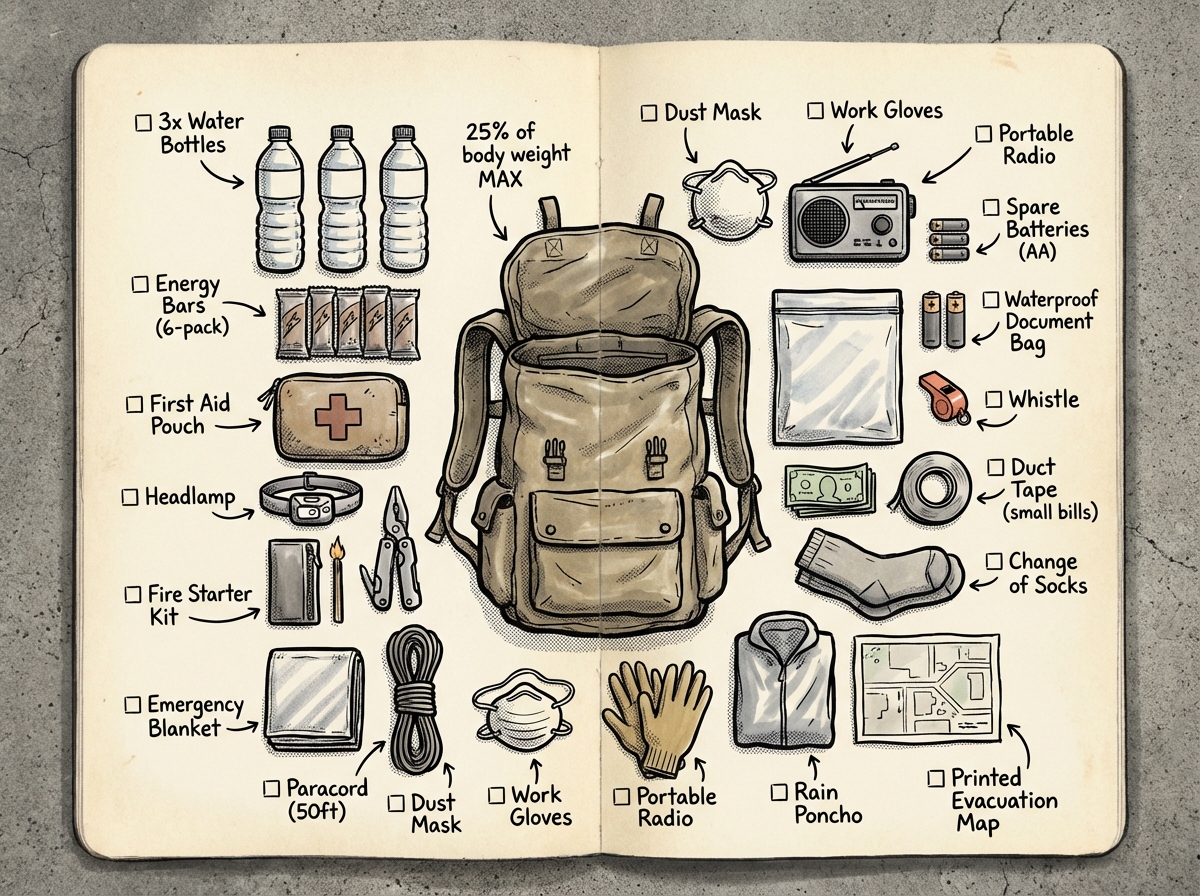 Complete 72-hour grab bag contents laid out and ready to pack
The first 72 hours of any disaster are the most chaotic and the most dangerous. Emergency services will be overwhelmed. In my experience responding to events in the Pacific Northwest, I’ve seen FEMA resources take 3–5 days to fully mobilize for a major disaster. You need to be self-sufficient during that window.
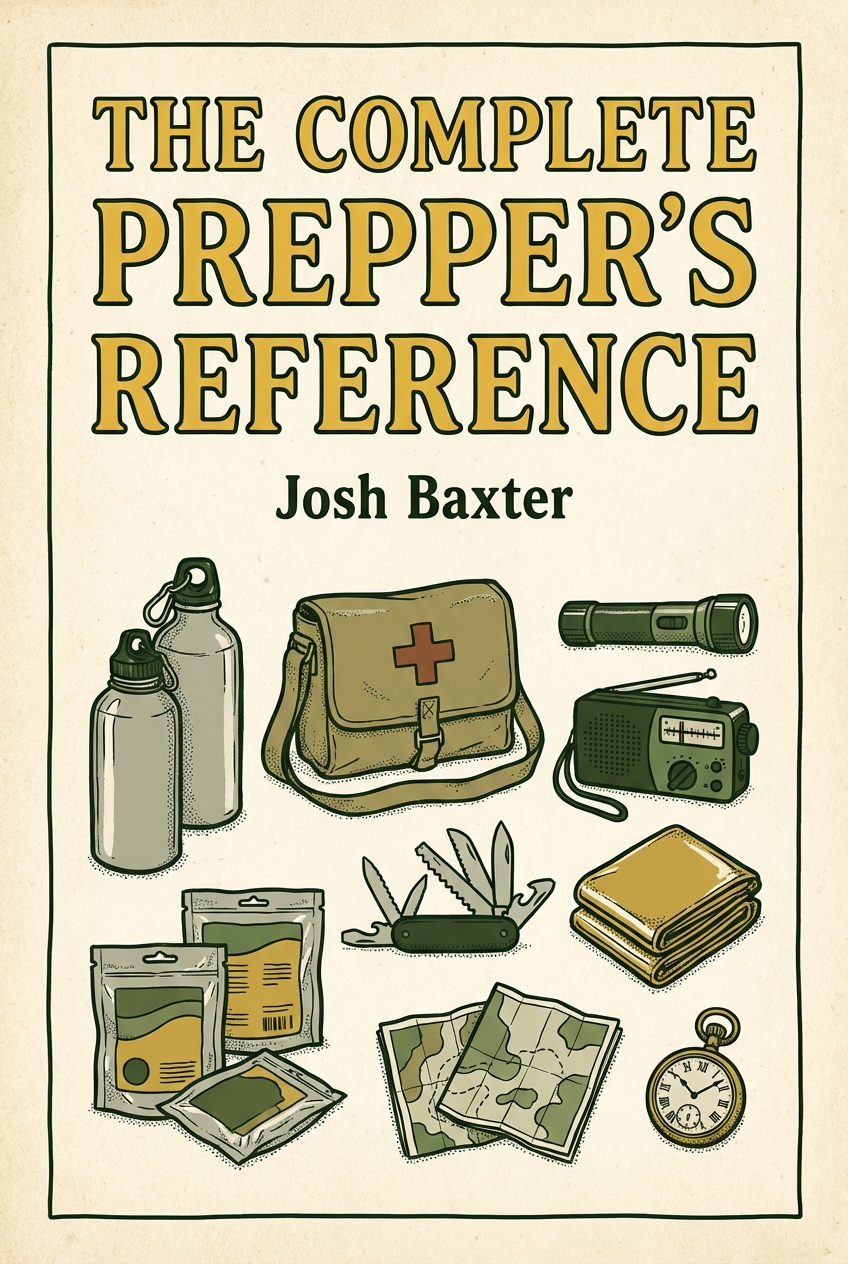
Your 72-hour emergency kit checklist should be portable — a single bag per person that you can grab and go in under 60 seconds.
- 1 gallon of water per person per day (3 gallons minimum)
- 3 days of non-perishable food (energy bars, freeze-dried meals, peanut butter)
- First aid kit with trauma supplies (tourniquet, chest seal, gauze)
- Battery-powered or hand-crank radio (NOAA weather band capable)
- Flashlight with extra batteries or a headlamp
- Multi-tool or fixed-blade knife
- Copies of important documents in a waterproof bag
- Cash in small bills ($200–$500)
- Prescription medications (7-day supply minimum)
- Change of weather-appropriate clothing and sturdy shoes
- Emergency blanket or compact sleeping bag
- Water purification tablets or a portable filter
I’ve tested dozens of bag configurations over the years. The biggest mistake people make is overpacking. Your bug out bag should weigh no more than 25% of your body weight if you expect to move with it on foot. Every ounce matters when you’re covering miles.
Step 2: Establish Evacuation Routes and Rally Points
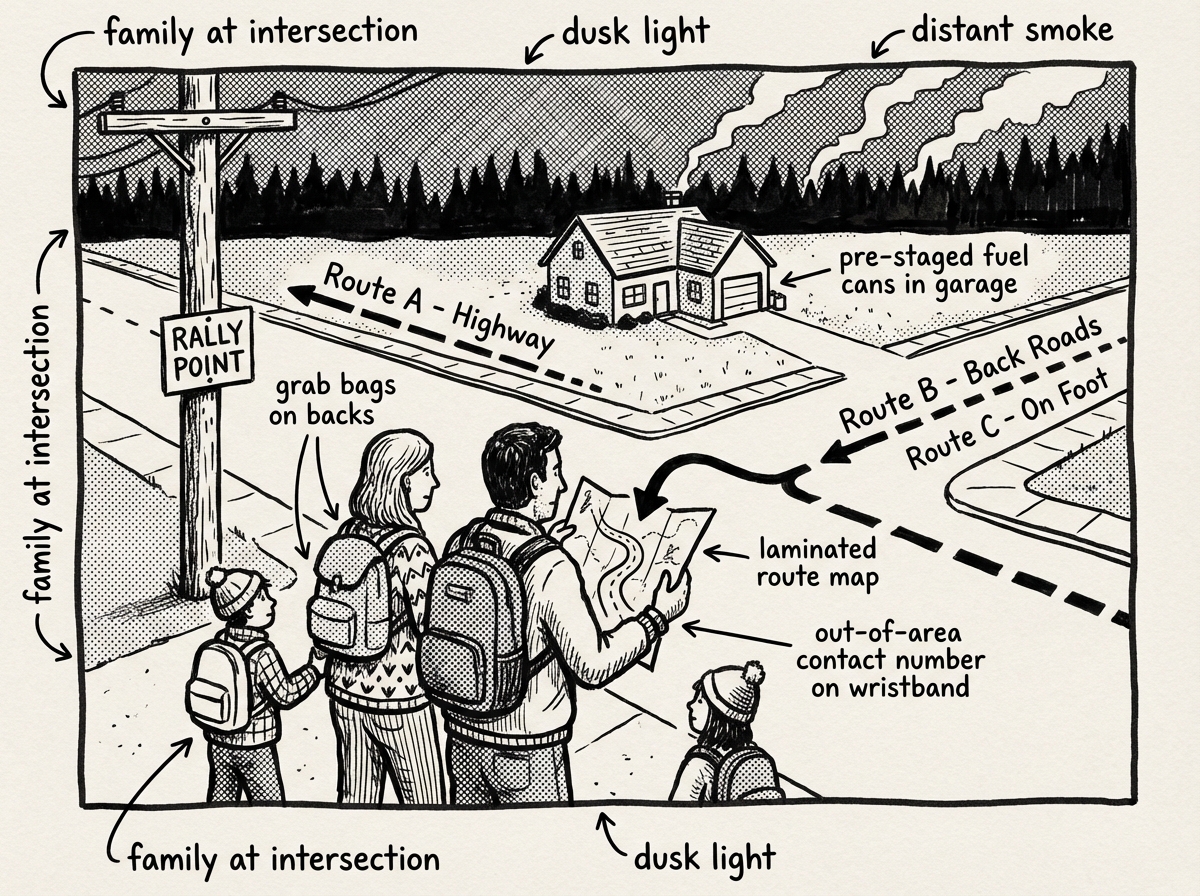 Family reviewing three marked evacuation routes at a neighborhood rally point
In every zombie movie, what kills people? Gridlock. Everyone tries to leave at once using the same roads, and they get trapped. This happens in real disasters too — I saw it during wildfire evacuations in Oregon where a single highway became a parking lot with flames closing on both sides.
- Identify three routes out of your neighborhood — primary, secondary, and a foot/bike path that avoids main roads
- Drive or walk each route during different times of day to understand traffic patterns and chokepoints
- Establish two rally points: one within 5 miles (for local evacuation) and one 50+ miles away (for regional disasters)
- Mark fuel stops, water sources, and potential shelter locations along each route
- Share all route details with every member of your household and one trusted out-of-area contact
For detailed methodology on route selection and mapping, see our full evacuation route planning guide.
The out-of-area contact is critical. During the 2001 attacks, local phone networks were jammed but long-distance calls often went through. Pick someone 500+ miles away who can serve as your information hub. Everyone in your family calls that one person to check in.
Step 3: Secure Your Water Supply
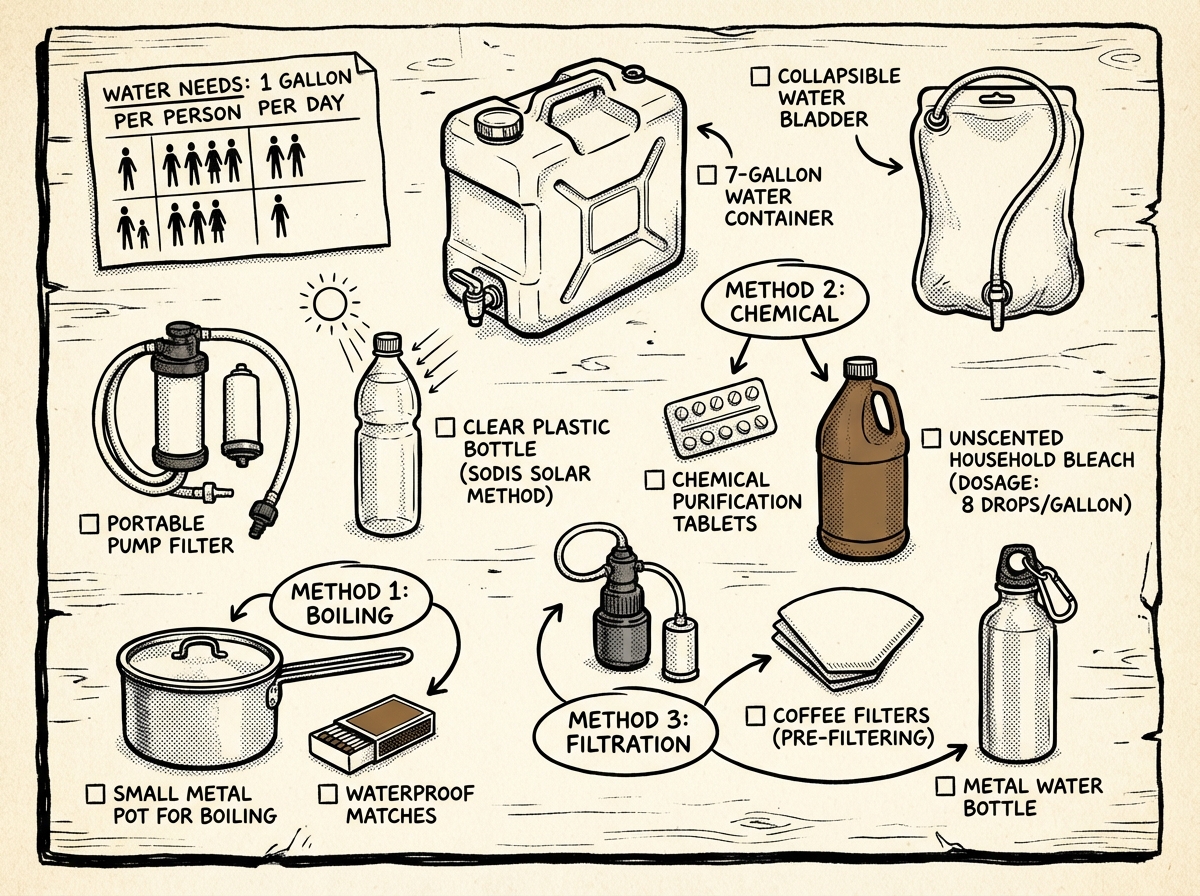 Three water purification methods and storage essentials laid out
I cannot stress this enough: water will be your most critical resource in any prolonged emergency. Not firearms. Not food. Water. You can survive three weeks without food but only three days without water, and even mild dehydration degrades your decision-making ability within hours.
During my WFR recertification field exercises in the Olympic Peninsula, I’ve tested Sawyer, Katadyn, and MSR filters side by side in glacial runoff — the Sawyer Squeeze consistently delivered the best flow rate for its weight. That kind of testing under real conditions is why I recommend it as the go-to portable filter.
For short-term preparedness, store one gallon per person per day. For a family of four planning for two weeks, that’s 56 gallons — roughly the size of a large rain barrel. For long-term scenarios, you need procurement and purification capability. Our full guide on water storage and purification methods covers this in depth.
- Portable water filters (like the Sawyer Squeeze or Katadyn BeFree) can purify thousands of gallons
- Boiling remains the gold standard — a rolling boil for one minute kills virtually all pathogens
- Chemical treatment with unscented household bleach (8 drops per gallon of clear water, 16 for cloudy) works in a pinch
- Rainwater collection is your most sustainable long-term solution — a 1,000 sq ft roof collects about 600 gallons per inch of rainfall
Store water in food-grade containers away from direct sunlight. Rotate your supply every 6–12 months. Add water preserver concentrate to extend shelf life up to 5 years without rotation.
Step 4: Fortify Your Base (Against Zombies AND Humans)
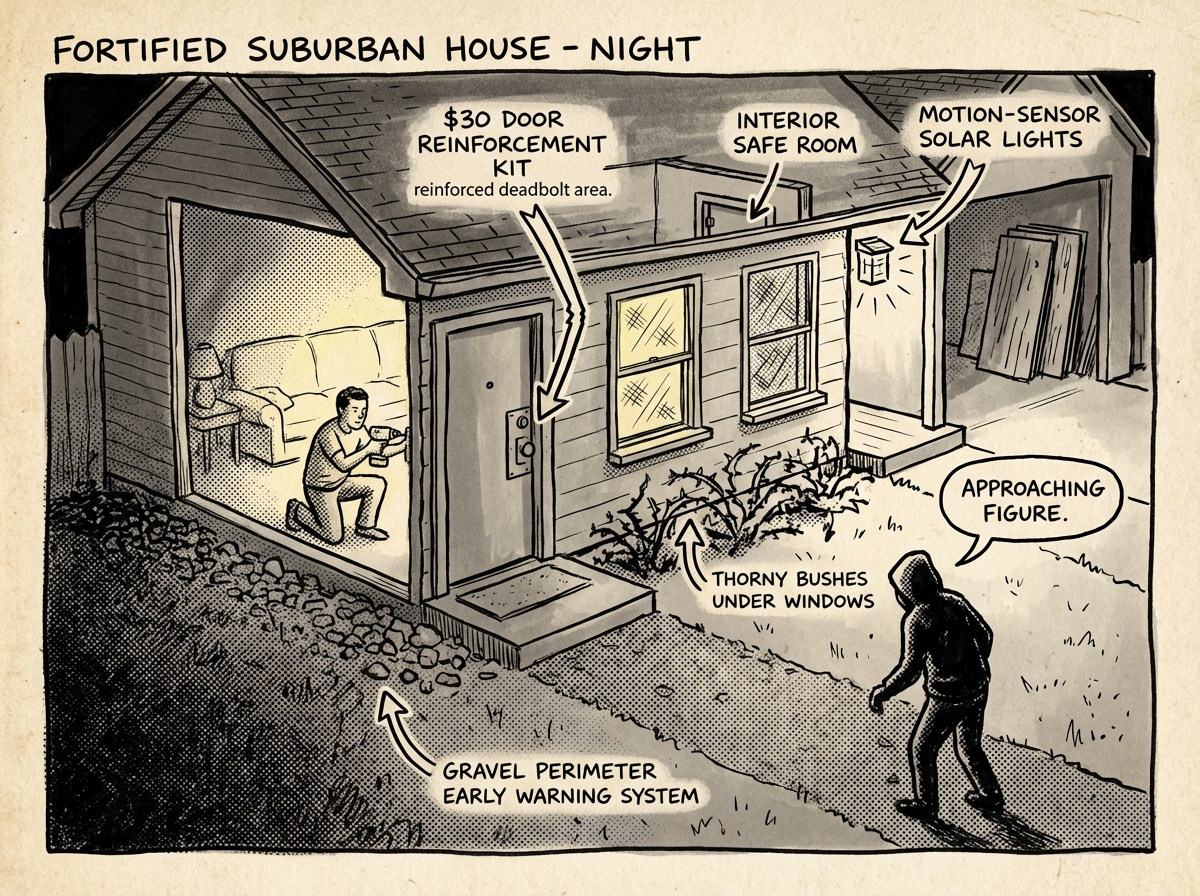 Home fortification measures shown in cross-section view
This is where zombie preparedness teaches a lesson that most polite disaster guides skip: in a prolonged crisis, other humans become a threat. I’ve seen it in post-disaster environments. When supply chains fail and people get desperate, your stockpile of food and water becomes a target.
After the 2021 Pacific Northwest heat dome killed over 600 people, I helped organize neighborhood mutual aid networks that later became the model for our community’s all-hazards preparedness group. That experience taught me that home security hardening and community trust go hand in hand — you can’t fortify effectively without neighbors who have your back.
Start with the basics:
- Reinforce entry points. A $30 door reinforcement kit (like a Door Armor set) makes a standard residential door dramatically harder to kick in.
- Secure windows. Security film won’t stop a determined breach, but it buys you time — and time is everything.
- Create early warning systems. Motion-sensor lights, gravel around your perimeter (you can hear footsteps on gravel at night), and battery-powered alarms on doors and windows.
- Establish sight lines. Trim vegetation around your home so you can see approaching threats from a distance.
- Plan fallback positions. If your ground floor is breached, where do you go? Have a plan for each floor and room.
The people who talk about three years of food stored away and a small homestead are thinking about this correctly. But the ones who plan for self-sufficiency without planning for defense are leaving a critical gap.
Step 5: Learn First Aid That Actually Matters
Your standard Red Cross first aid course is great for everyday life. For a SHTF preparedness scenario — zombie or otherwise — you need trauma medicine skills.
As a certified Wilderness First Responder, I train for situations where evacuation to a hospital isn’t possible for hours or even days. I’ve taught hemorrhage control to over 300 community members through Stop the Bleed workshops in Portland and Tacoma, and I recertify my WFR credential every two years through NOLS Wilderness Medicine. That’s the exact scenario you’d face in any major disaster.
Here are the skills that matter most:
- Hemorrhage control — tourniquets, wound packing, pressure dressings. Uncontrolled bleeding is the #1 preventable cause of death in trauma.
- Airway management — knowing how to position an unconscious person and clear an obstructed airway.
- Splinting and immobilization — improvised splints using sticks, clothing, and duct tape.
- Wound care and infection prevention — cleaning wounds, recognizing infection signs, basic wound closure strips.
- Medication knowledge — understanding common antibiotics, pain management, and how to use what’s available.
Your family has evacuated to a rural property 40 miles from the nearest hospital. On day three, your teenager slips while carrying water and gashes their forearm on a piece of exposed metal. The wound is deep and bleeding heavily. Cell service is down. The nearest medical facility is unreachable. Do you know how to control the bleeding, clean the wound, close it, and prevent infection? This scenario plays out in every extended disaster — not just zombie ones.
Take a Stop the Bleed course (they’re free and offered nationwide). If you can, invest in a Wilderness First Aid or WFR certification. It’s the single most valuable survival skill I’ve ever learned.
What’s the Safest Location to Survive a Zombie Apocalypse?
This question comes up constantly, and the answer is more nuanced than most people expect. Everyone’s zombie survival guide involves heading to rural locations, but it wouldn’t be as secluded as people think when millions of others have the same idea.
A 2025 study by CanadaCasino evaluated all 50 U.S. states on six key metrics: population density, geographic barriers, natural resources, agricultural capacity, climate, and infrastructure resilience. States in the Mountain West — Montana, Wyoming, Idaho, and Alaska — consistently ranked at the top. High-density states like New Jersey, Rhode Island, and Connecticut ranked near the bottom. The single biggest variable? Population density, which mathematical outbreak modeling confirms drives contagion spread more than any other factor.
Researchers at Carleton University and the University of Leicester have both used SIR (Susceptible-Infected-Recovered) epidemiological models to simulate zombie outbreaks. Their results consistently show that densely populated urban corridors collapse within days, while isolated rural communities with natural geographic barriers — mountain ranges, large rivers, coastlines — can sustain indefinitely if properly supplied.
Internationally, Canada, Iceland, and Australia rank highly due to vast uninhabited areas, natural barriers, and abundant freshwater resources.
But here’s what I’ve learned from years of field work: your preparation matters infinitely more than your location. A well-prepared family in suburban Portland will outlast an unprepared family in rural Montana every time. Location is a multiplier, not a foundation.
The ideal characteristics for a survival base are:
- Access to a natural water source (river, spring, lake)
- Defensible terrain (elevation advantage, limited approach routes)
- Agricultural potential (arable land, sufficient growing season, adequate rainfall)
- Distance from major population centers (50+ miles from any city over 100,000)
- Proximity to a small community (because long-term survival requires people, not isolation)
Communication: The Most Underrated Survival Skill
When the grid goes down, your ability to gather information and coordinate with others becomes your biggest advantage. In every disaster I’ve responded to, the groups that maintained communication survived at dramatically higher rates than those operating blind.
I hold a General-class amateur radio license and volunteer with my county’s ARES (Amateur Radio Emergency Service) team. During our annual SET (Simulated Emergency Test) exercises, we practice exactly the grid-down communication scenarios described here. I’ve seen firsthand how communication breakdown causes real problems — during one PNW winter storm response, two volunteer teams converged on the same location while an entire neighborhood went unchecked for 36 hours, simply because their radio relay failed and there was no backup protocol.
Your emergency communication plan should include these layers:
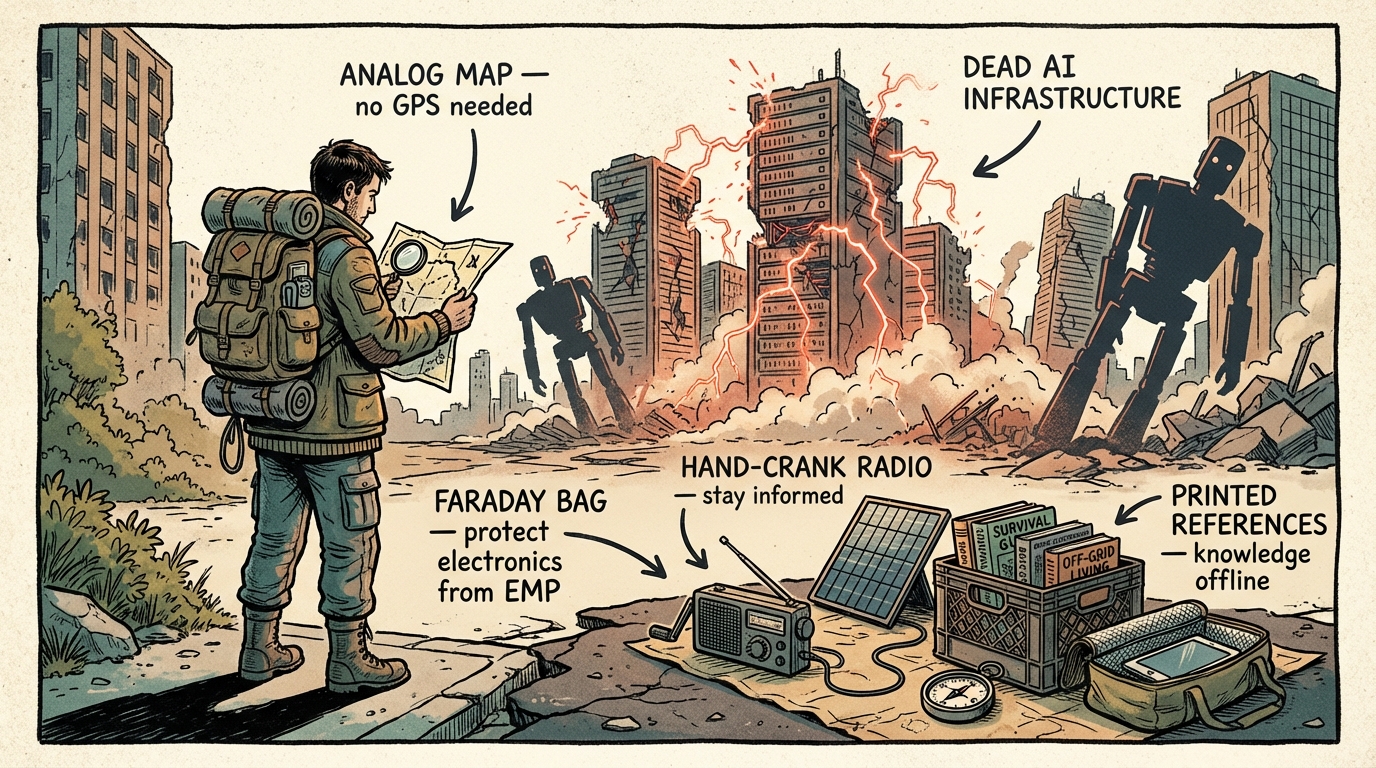
- NOAA weather radio — battery or hand-crank powered, always accessible. This is your first source of official information.
- HAM radio — at minimum, a Baofeng UV-5R for around $25. Get your Technician license (35-question multiple-choice exam, no Morse code, study for free at hamstudy.org, $35 exam fee). The Technician license gives you access to local repeaters. A General license opens long-distance HF bands.
- Mesh networking devices — products like goTenna Mesh allow phone-to-phone communication without cell towers, creating ad hoc networks within a few miles. These are excellent for coordinating with nearby group members.
- Predetermined check-in times with family and allies — every 12 hours on a specific frequency or at a physical rally point.
- Physical message boards at rally points (a waterproof notebook in a ziplock bag, secured at a fixed location).
- Signal plans — visual and auditory signals for your immediate group (whistle patterns, light signals, marker flags).
A critical note on OPSEC (operational security): in a prolonged crisis, broadcasting your location, group size, or resource stockpile over open radio channels is an invitation for trouble. Keep transmissions brief, use pre-arranged code words for sensitive information, and monitor more than you transmit. The zombie preparedness angle makes this intuitive — you wouldn’t shout your address into a megaphone during a zombie outbreak, and you shouldn’t do the radio equivalent during any disaster.
Don’t underestimate the value of a simple, battery-powered AM/FM radio. In the early stages of any disaster, broadcast radio is often the most reliable source of official information.
Long-Term Survival: Building Self-Sufficiency
If the zombie scenario drags on — and in real life, major disasters can disrupt supply chains for weeks or months — your stored supplies will eventually run out. That’s when self-sufficiency skills become everything.
Food Production: The Survival Trifecta
Start with the three crops that have sustained human survival for centuries: potatoes, beans, and squash. Together, they provide carbohydrates, protein, essential vitamins, and caloric density. In a decent growing season, a single 100-square-foot garden bed can produce roughly 150–200 pounds of potatoes — that’s approximately 100,000 calories, or enough to sustain one person for about 50 days.
For a comprehensive starting plan, check out our beginner survival garden guide.
Store your seeds in cool, dark, dry conditions. Vacuum-sealed seed packets stored below 40°F can remain viable for 5–10 years depending on the variety. Focus on open-pollinated and heirloom varieties — you can save seeds from these plants year to year, unlike hybrids.
Food Preservation
Growing food is only half the challenge. Preserving it through winter or lean periods is equally critical:
- Water bath canning for high-acid foods (tomatoes, pickles, fruits)
- Pressure canning for low-acid foods (meats, beans, vegetables) — requires a pressure canner, not just a pot
- Dehydrating with solar dehydrators or low-heat ovens extends shelf life dramatically
- Smoking and salting for meat preservation without refrigeration
The Barter Economy
In prolonged disruptions, currency loses meaning and skills become the real currency. Historical examples bear this out — during the Siege of Sarajevo (1992–1996), lighters, antibiotics, batteries, alcohol, and hygiene items became more valuable than money. The skills that command the highest trade value are medical knowledge, mechanical repair, food preservation, and security.
Start a small garden now, even if it’s just a few containers on a balcony. The learning curve for food production is steeper than most people realize. I’ve watched experienced outdoor professionals struggle with their first serious vegetable garden — start learning while the stakes are low.
Community Is Your Most Valuable Prep
The lone-wolf fantasy is just that — a fantasy. Every long-term survival scenario, whether historical or simulated, demonstrates that organized groups of 15–50 people with diverse skill sets dramatically outlast individuals. Post-Katrina, the neighborhoods that recovered fastest were those with pre-existing community organizations that could coordinate resource distribution, security, and mutual aid. Your community is your most valuable prep.
Psychological Survival: The Threat No One Talks About
Here’s something that doesn’t make it into most zombie survival guides: psychological collapse kills more people in prolonged disasters than most physical threats. Depression, panic, decision fatigue, and loss of purpose can render even a well-supplied survivor unable to function.
In my field experience, the responders and survivors who maintained mental health did a few specific things:
- Maintained routines — wake time, meal times, task schedules, sleep time. Structure prevents spiraling.
- Protected sleep — sleep deprivation degrades decision-making faster than almost anything. Establish watch rotations so everyone gets 6+ hours.
- Managed light cycles — in grid-down situations, your circadian rhythm collapses without intentional light management. Candles, lanterns, and fire provide more than just illumination — they anchor your body’s clock.
- Created purpose — assign roles and responsibilities to everyone, including children. People who feel useful stay psychologically stable.
- Practiced normalcy rituals — shared meals, storytelling, games, anything that reinforces “we are still human, this is still a life.”
This is one reason community matters so much. Isolation feeds despair. A group provides conversation, accountability, shared humor, and the basic human connection that keeps people from giving up.
Zombie Apocalypse Survival Preparedness for Families and Schools
One of the most powerful applications of the zombie preparedness framework is engaging kids and families in emergency planning. The CDC figured this out, the American Red Cross built an entire youth activity guide around it, and I’ve seen it work in my own community workshops.
Making Emergency Planning Age-Appropriate
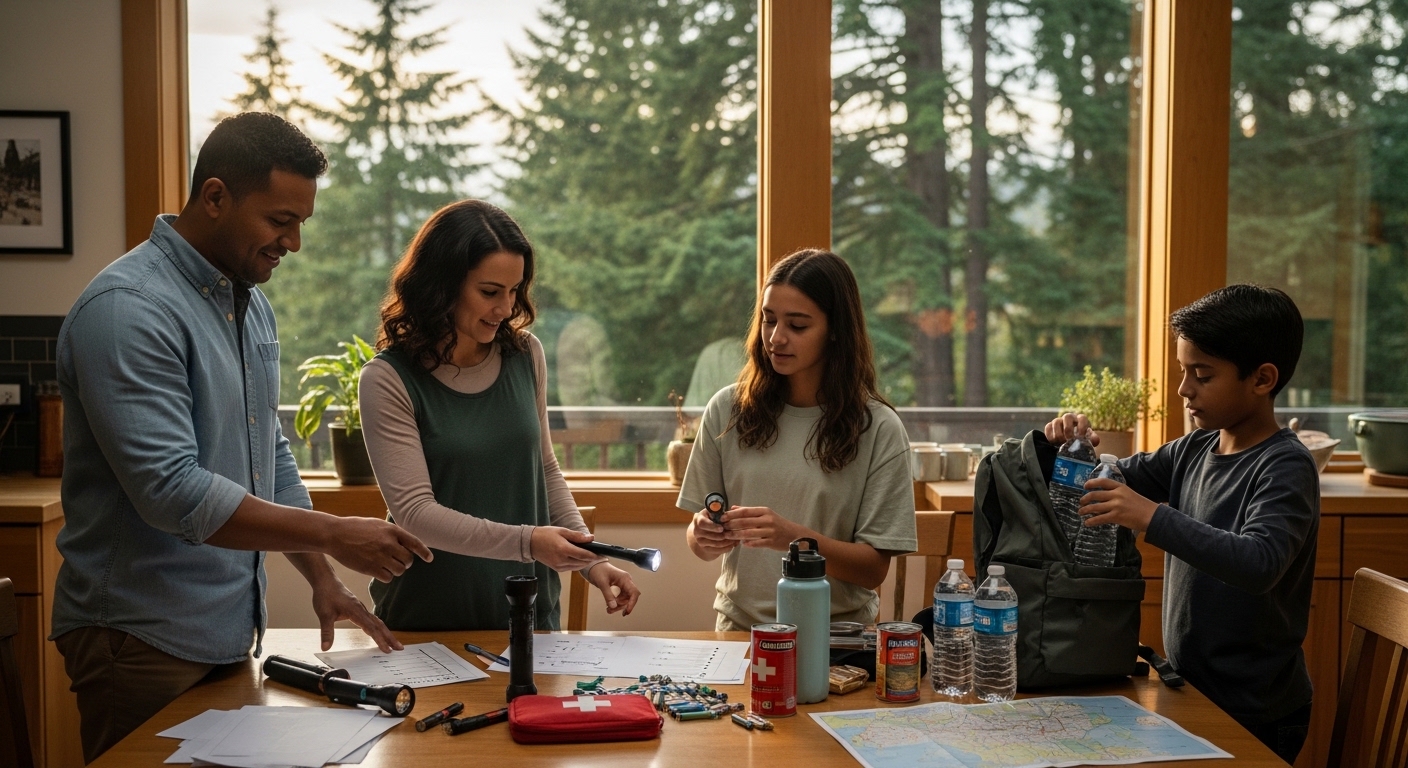
Young children (ages 5–8) can learn to memorize a family rally point, recognize the sound of a smoke alarm, and pack a small personal emergency bag with a stuffed animal, a snack, and a flashlight. Frame it as “zombie adventure preparation” and they’ll be excited rather than scared.
Older kids (ages 9–14) can handle more responsibility: learning to use a weather radio, understanding evacuation routes, and practicing basic first aid. I’ve seen twelve-year-olds learn tourniquet application in 15 minutes when it’s presented as zombie survival training.
Schools and Community Groups
Schools can use the CDC zombie framework for disaster drills that students actually pay attention to. Instead of the standard fire drill that kids sleepwalk through, a “zombie evacuation drill” gets genuine engagement while teaching the same skills — orderly evacuation, rally point assembly, headcount procedures, and communication protocols.
The American Red Cross zombie apocalypse activity guide is specifically designed for youth groups, Scout troops, and classroom settings. It covers emergency kit building, family communication plans, and community preparedness — all wrapped in zombie scenarios that keep kids engaged.
Family Communication Plans Kids Can Memorize
Every child in your household should be able to recite from memory:
- The family’s out-of-area contact name and phone number
- The two rally point locations (local and regional)
- Their full home address (for younger children in case they need to tell an adult)
- The rule: “If we get separated, go to [rally point] and wait”
Practice these quarterly. Make it a game. Quiz them at dinner. The zombie framing makes kids more engaged with preparedness than any traditional approach I’ve ever tried.
Common Mistakes That Get People Killed
After more than a decade in emergency management, I see the same errors repeated constantly:
Over-prioritizing weapons, under-prioritizing water. I’ve met preppers with $10,000 in firearms and $50 in water storage. Invert those numbers and you’ll survive longer.
Failing to practice. Your evacuation plan is worthless if you’ve never run it. Your fire-starting kit is worthless if you’ve never used it in the rain. Practice under realistic conditions at least twice a year.
Ignoring physical fitness. Every survival scenario demands physical exertion — carrying packs, moving debris, walking long distances. If you can’t hike five miles with a loaded pack, that’s your most urgent prep gap.
Planning for solo survival. You need to sleep. You need diverse skills. You need someone watching your back. Build relationships with like-minded neighbors now.
Assuming it won’t happen to them. The Pacific Northwest will experience a magnitude 9.0 earthquake. It’s not a matter of if, it’s when. The same is true for your region’s primary threats, whatever they are.
Neglecting mental health preparedness. Having supplies without psychological resilience is like having a car without a driver. Build routines, protect sleep, and plan for the emotional toll of a crisis — not just the physical one.
Frequently Asked Questions
What’s the best way to prepare for a zombie apocalypse?
The best way to prepare for a zombie apocalypse is to follow the same proven disaster preparedness steps recommended by the CDC and FEMA. Build a 72-hour emergency kit with water, food, first aid supplies, and documents. Establish three evacuation routes and two rally points. Create a family communication plan with an out-of-area contact. Learn trauma first aid through a free Stop the Bleed course. Fortify your home’s entry points. Build a prepared community of neighbors with diverse skills. Then practice everything under realistic conditions at least twice a year. The zombie framing is just the wrapper — these skills protect you against earthquakes, pandemics, wildfires, and prolonged power outages.
What is the safest country to survive a zombie apocalypse?
Studies and simulations consistently rank Canada, Australia, and Iceland as the safest countries due to low population density, geographic isolation (oceans, mountain ranges, vast wilderness), and abundant natural resources including fresh water. Within the United States, the 2025 CanadaCasino study ranked Mountain West states — Montana, Wyoming, Alaska, and Idaho — highest based on population density, geographic barriers, natural resources, agricultural capacity, climate, and infrastructure resilience. Mathematical SIR models from universities including Carleton and Leicester confirm that population density is the single biggest variable in outbreak spread. That said, your personal preparation level matters more than your GPS coordinates. A prepared family in a moderate-risk area will outlast an unprepared family anywhere.
Zombie Apocalypse Survival Preparedness Starts Today
Here’s the thing about zombie apocalypse survival preparedness — every single skill, supply, and plan we’ve discussed in this guide protects you against real threats that exist right now. Pandemics, earthquakes, hurricanes, wildfire evacuations, prolonged power outages, supply chain collapses. The zombies are just the wrapper. The preparation is real.
The CDC used zombies to get your attention. The Department of Defense used them to train strategic planners. I use them to fill community preparedness workshops. The framework works because it forces you to confront the worst case honestly — and the skills transfer to every real disaster you’ll actually face.
Start with the 72-hour kit. Today. Not this weekend, not next month. Grab a backpack, fill a few water bottles, throw in some granola bars and a flashlight, and put it by your door. It won’t be perfect — mine wasn’t when I started over a decade ago. But it’ll exist, and something beats nothing every single time.
Then build from there. Add a week’s worth of water storage. Walk your evacuation routes. Take a Stop the Bleed course. Get a weather radio. Start a garden. Talk to your neighbors. Each step makes you meaningfully more resilient against whatever comes — shambling undead or otherwise.
What’s the first thing you’re going to do today to be more prepared than you were yesterday?