What You Need to Know
- →Cell networks typically fail within 2-4 hours during major emergencies due to tower overload — your phone is not a communication plan.
- →NOAA Weather Radio broadcasts on seven dedicated frequencies and provides real-time alerts before, during, and after disasters.
- →Ham radio operators provided critical communications during Hurricane Katrina and other major disasters when all other infrastructure failed.
- →Satellite communicators like the Garmin inReach can send SOS signals and two-way messages from anywhere on Earth — no cell tower required.
Why Your Phone Isn't Enough: Understanding Communication Failures
Here's the hard truth most people learn too late: cell networks typically fail within 2-4 hours during major emergencies. Tower overload, power outages, and physical damage to infrastructure all conspire to kill your connection right when you need it most. I've watched it happen during ice storms, wildfires, and earthquake drills across the Pacific Northwest. The assumption that you can just "call for help" is the single biggest gap in most people's emergency plans. A layered communication strategy — combining multiple device types that operate on different networks and power sources — is what separates people who stay informed and connected from those who are left in the dark. This guide walks you through every layer, from the simplest hand crank radio to advanced ham radio networks and satellite technology.
Hand Crank Radios: Your First Line of Emergency Information
A hand crank radio is the foundational piece of any emergency communication kit. These devices require no grid power — you generate electricity by turning a crank, and many models also include solar panels and USB charging ports for your other devices. The best models receive NOAA Weather Radio frequencies, giving you access to real-time emergency alerts and forecasts. Key features to look for include:
- NOAA Weather Band reception with SAME alert technology
- Multiple power sources: hand crank, solar panel, USB, and battery backup
- Built-in flashlight and USB charging port for phones
- Durable, water-resistant construction
- AM/FM reception for general emergency broadcasts
For beginners, a quality hand crank radio is the single best return on investment in emergency preparedness. It's simple, requires no license, and works when everything else is down.
Emergency Communication Devices: Building a Layered Backup Plan
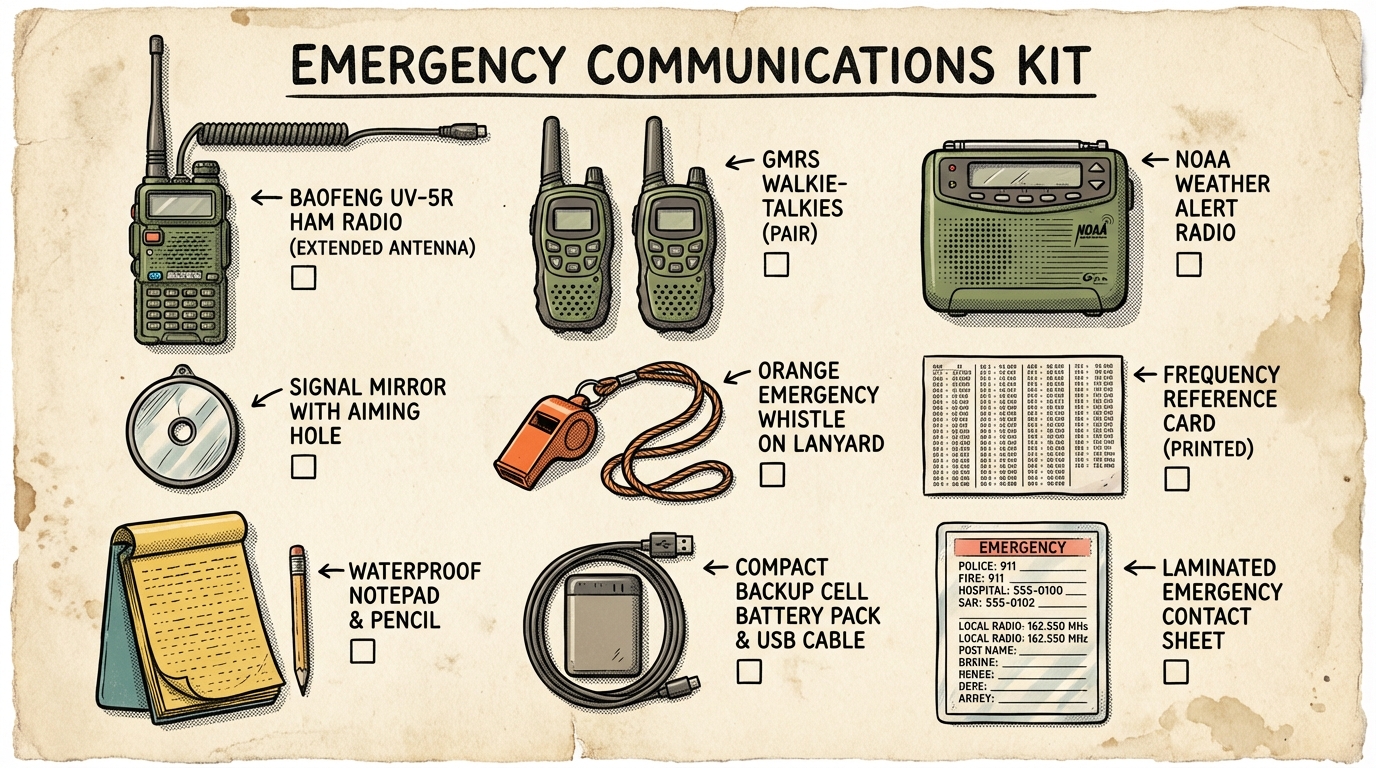
Beyond basic radios, a reliable emergency communication plan uses multiple device types across different technologies. NOAA weather radios provide passive monitoring and automated alerts. Two-way radios (FRS/GMRS) let you communicate with family and neighbors within a few miles. Satellite communicators like the Garmin inReach operate completely independent of terrestrial infrastructure — they bounce signals off satellites to send SOS alerts, GPS coordinates, and two-way text messages from anywhere on Earth. Key categories to consider:
- NOAA Weather Radios: Automated alerts, no license needed
- FRS/GMRS Two-Way Radios: Short-range family communication (GMRS requires a simple license)
- Satellite Communicators: Global coverage, SOS capability, subscription required
- Personal Locator Beacons (PLBs): One-way SOS signal to search and rescue — no subscription
The goal is redundancy. No single device covers every scenario, so layer your plan with at least two to three different technologies.
Ham Radio: The Backbone of Disaster Communications
When every other system fails, ham radio keeps working. Amateur radio operators have been the backbone of disaster communications for decades, providing critical links during Hurricane Katrina, wildfires, and countless other emergencies when commercial infrastructure collapsed. Getting started requires an FCC Technician license — a straightforward exam that covers basic radio theory and regulations. From there, you can build a ham radio emergency kit that includes a handheld (HT) radio, a mobile or base station, and knowledge of local repeater frequencies and emergency nets. Key steps to get started:
- Study for and pass the FCC Technician exam
- Start with an affordable handheld transceiver (HT)
- Program local repeater frequencies and ARES/RACES emergency nets
- Practice regularly — join local nets and emergency drills
- Build a go-kit with your radio, spare batteries, antenna, and frequency reference card
Ham radio isn't just a device — it's a skill set. The license process teaches you how radio works, which makes you far more effective in a real emergency.
Technology and Apps That Enhance Emergency Preparedness
Smart use of technology can dramatically improve your emergency readiness without making things overwhelming. Weather alert apps, offline mapping tools, and emergency notification systems all serve as early warning layers that complement your hardware. The key is setting up these tools before disaster strikes, so they work automatically when you need them. Practical tech enhancements include:
- FEMA App and Wireless Emergency Alerts (WEA): Free, automatic push notifications for your area
- Offline maps and GPS apps: Navigation when cell data is unavailable
- Emergency contact and document storage apps: Keep critical info accessible on your phone
- Solar chargers and power banks: Keep your devices alive when the grid is down
- Mesh networking apps: Some apps enable phone-to-phone communication without cell service
Technology is a force multiplier, but it's not a replacement for hardware that works without the internet. Use apps as your early-warning layer and physical devices as your reliability layer.
Drones in Emergency Preparedness: Scouting, Rescue, and Assessment
Drones are changing the game for emergency preparedness and disaster response. They provide rapid aerial scouting of evacuation routes, damage assessment after storms or earthquakes, and critical support for search and rescue operations — all without putting people in danger. For individual preparedness, a consumer drone can help you assess property damage, scout flooded roads, or locate family members in a large area. In organized response, drones equipped with thermal cameras have located survivors that ground teams couldn't reach. Key applications include:
- Pre-disaster route scouting and property documentation
- Post-disaster damage assessment from a safe distance
- Search and rescue support with thermal and visual cameras
- Delivering small emergency supplies to inaccessible areas
- Real-time situational awareness for community response teams
Drone technology is becoming more accessible and affordable. If you're already into preparedness, adding a drone to your toolkit gives you an aerial perspective that no other tool can match. Be aware of FAA regulations and temporary flight restrictions during declared emergencies.
After 12 years of field work and real-world disaster response, I'll tell you this: the people who communicate during emergencies are the people who prepared their comms plan before the emergency. Start with a quality hand crank radio and a pair of FRS radios — that covers 80% of scenarios for most families. If you want to go deeper, get your ham radio license; it's the single most powerful communication capability a civilian can own, and the skill set you build earning it is worth more than the radio itself.
Get the Free Reference Guide
149 articles synthesized into one comprehensive PDF — free with your email.
You're in! Check your inbox for the free guide.
Unsubscribe anytime. We respect your privacy.
Deep-Dive Articles (5)
Best Hand Crank Radios for Emergencies
Discover the best hand crank radios for emergencies, with beginner-friendly reviews, must-have features, and tips for choosing the right model.
Best Emergency Communication Devices: A Beginner's Guide
Discover the best emergency communication devices for beginners — from NOAA radios to satellite communicators. Build a reliable backup plan today.
Ham Radio Emergency Preparedness: A Field Guide
Ham radio emergency preparedness explained by a FEMA-trained responder. Gear, licensing, frequencies, and step-by-step starter plan. Start building your comms kit today.
How to Use Technology to Enhance Your Emergency Preparedness
Discover the best tech tools, apps, alerts, and communication gear to boost emergency preparedness without making prepping feel overwhelming.
The Role of Drones in Emergency Preparedness
Learn how drones improve emergency preparedness with faster scouting, search and rescue support, damage assessment, and smarter prepper planning.