July–September Prep Checklist
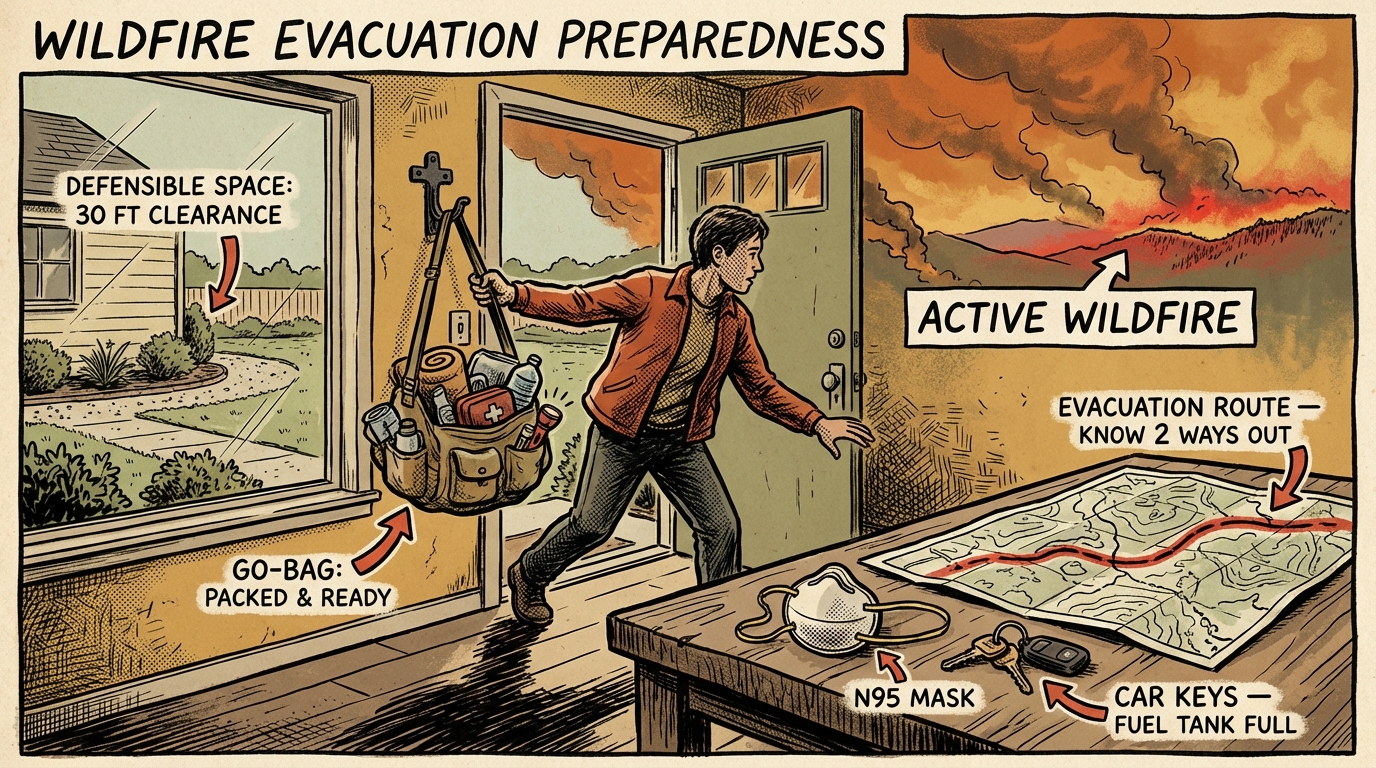
- Sign up for your county's emergency alert system and confirm notifications are enabled on your phone
- Map two evacuation routes from your home and drive both before July 1st
- Pack a 72-hour go bag for each family member and store it by the door or in your vehicle
- Store $200 in small bills, copies of all critical documents, and a 7-day medication supply in your go bag
- Stock at least 4 N95 respirator masks per household member
- Create and maintain defensible space in all three zones around your home — schedule annual maintenance by June 1st
- Replace or cover attic, soffit, and foundation vents with 1/8-inch metal mesh screening
- Record a room-by-room video inventory of your home and upload it to encrypted cloud storage
- Designate an out-of-area emergency contact and ensure every family member has their phone number memorized or printed
- Print contact cards with emergency numbers and place one in every go bag, wallet, and child's backpack
- Run a timed evacuation drill with your full household and achieve a departure time under 10 minutes
- Review your homeowner's or renter's insurance policy for wildfire coverage and adequate replacement cost before fire season
Understanding the Wildfire Threat
Wildfires are not just a California problem. From Oregon to Montana, Colorado to New Mexico, wildfire risk has expanded dramatically due to prolonged drought, increased fuel loads, and development pushing deeper into the wildland-urban interface. Modern wildfires move faster than they did a generation ago — wind-driven fires can advance at speeds exceeding 14 miles per hour, outpacing a person on foot.
Key risk factors to assess for your location include:
- Proximity to wildlands: If you live within 1 mile of undeveloped forest, brush, or grassland, your risk is elevated.
- Topography: Fires accelerate uphill. Homes on slopes or in canyons face greater exposure.
- Access routes: Communities with limited egress roads are especially vulnerable to evacuation bottlenecks.
- Local fire history: Check your county's Community Wildfire Protection Plan (CWPP) or use the USDA's Wildfire Risk to Communities tool at wildfirerisk.org.
Understanding your specific risk profile is the foundation of every decision that follows.
Creating Defensible Space Around Your Home
Defensible space is the buffer you create between your home and the wildland fuels that surround it. This is not optional — it is the single most effective thing you can do to improve your home's survival odds, and in many western states, it's required by law.
Work in three zones:
- Zone 1 (0–5 feet from structures): This is the most critical zone. Use hardscape like gravel, stone, or concrete. Remove all combustible materials — mulch, dead plants, woodpiles, propane tanks, patio furniture cushions, and dry leaves in gutters.
- Zone 2 (5–30 feet): Create spacing between trees and shrubs. Remove ladder fuels — the low-hanging branches and brush that allow ground fire to climb into tree canopies. Keep grass mowed to 4 inches or less.
- Zone 3 (30–100 feet): Thin trees so canopies have at least 10 feet of separation. Remove dead wood and debris from the forest floor. Reduce density so fire cannot sustain crown-to-crown spread.
Schedule a defensible space assessment through your local fire department — many offer these for free. Do your annual maintenance in late spring before fire season arrives.
Building Your Wildfire Go Bag
Your wildfire go bag is a pre-packed kit that lives by the door or in your vehicle during fire season. It should sustain your family for 72 hours and contain everything you cannot replace. I keep mine in a 40-liter duffel that I can throw in the truck in under 30 seconds.
Essentials for your go bag:
- Documents: Copies of IDs, insurance policies, property deeds, medical records, and prescriptions in a waterproof pouch. Better yet, store digital copies in encrypted cloud storage.
- Water and filtration: 1 liter per person plus a portable filter like a Sawyer Squeeze.
- Food: Calorie-dense bars, trail mix, or freeze-dried meals — enough for 72 hours per person.
- N95 respirator masks: Minimum two per family member. Wildfire smoke is a serious respiratory hazard even miles from the fire front.
- Medications: A 7-day supply of all prescription medications, rotated monthly.
- Cash: At least $200 in small bills. Power outages disable ATMs and card readers.
- Clothing: One change per person — long sleeves, long pants, sturdy closed-toe shoes.
- Phone charger and battery bank: Fully charged, minimum 10,000 mAh capacity.
- Flashlight and headlamp: With spare batteries. Smoke can turn daylight into near-darkness.
Review and rotate perishable items every six months. I put a reminder on my calendar for May 1st and November 1st.
Your Evacuation Plan: Know Before You Go
An evacuation plan made during an emergency is not a plan — it's panic with extra steps. Build yours now, rehearse it, and make sure every member of your household knows it by heart.
Critical components:
- Know your evacuation levels: Most western counties use a three-tier system — Level 1 (Be Ready), Level 2 (Be Set), Level 3 (GO). Sign up for your county's emergency alert system today. Do not rely solely on your phone — have a NOAA weather radio as backup.
- Map two evacuation routes: Your primary route and an alternate. Fires shift direction, and roads close without warning. Drive both routes in advance so they're familiar under stress.
- Designate a meeting point: Choose a location outside your immediate area — a relative's home, a hotel in a neighboring town, or a community shelter. Make sure every family member knows the address.
- Account for pets and livestock: Identify pet-friendly shelters and have carriers, leashes, and vaccination records ready. Livestock owners should have a trailer hookup plan with a neighbor or friend.
- Practice the plan: Run a timed drill at least once before fire season. Time yourself from alert to vehicle departure. Your target is under 10 minutes.
When Level 2 arrives, load the car. Do not wait for Level 3 if you have children, elderly family members, mobility challenges, or large animals to transport.
Communication Plan and Emergency Contacts
During wildfire evacuations, cell towers become overloaded, lose power, or burn. Your communication plan needs to account for the reality that your phone may not work when you need it most.
- Designate an out-of-area contact: Choose someone in a different state who serves as your family's information hub. Everyone checks in with that person — even when you can't reach each other directly.
- Text before calling: Text messages require less bandwidth than voice calls and are more likely to get through on congested networks.
- Keep a printed contact card: In your go bag, in your wallet, and in your child's backpack. Include names, phone numbers, the out-of-area contact, your insurance agent, and your veterinarian.
- Download offline maps: Save your evacuation routes in Google Maps or a GPS app for offline use. Cellular data may be unavailable.
- Monitor official sources: Follow your local Office of Emergency Management on social media, bookmark InciWeb (inciweb.wildfire.gov) for active fire information, and use the Watch Duty app for real-time community fire reports in western states.
I also recommend a handheld two-way radio (FRS/GMRS) as a backup. In 2020, my cell service went down for 36 hours during the Oregon Labor Day fires. My handheld radio was the only way I coordinated with my neighbors.
Preparing Your Family and Household
Preparation is not just physical — it's emotional and logistical. Every person in your household, including children, needs to understand what happens when the alert comes.
- Talk to your kids: Use age-appropriate language. Frame preparation as empowering, not frightening. Let them pick a comfort item to add to the go bag — a stuffed animal, a book, a small game.
- Document your home: Walk through every room and record a video inventory of your belongings for insurance purposes. Store this video in the cloud and share access with your out-of-area contact.
- Prepare your home for departure: Create a quick shutdown checklist posted inside a kitchen cabinet — close all windows and doors, move flammable furniture away from windows, shut off gas at the meter, leave exterior lights on so your home is visible to firefighters through smoke, connect garden hoses.
- Neighbors matter: Exchange phone numbers with at least three nearby neighbors. In fast-moving evacuations, a knock on the door from a neighbor has saved more lives than any app notification. Check on elderly or mobility-limited neighbors as part of your plan.
- Insurance review: Verify your homeowner's or renter's policy covers wildfire and includes adequate replacement cost. Review annually. Photograph your policy declarations page and add it to your document kit.
Preparedness done together builds confidence. When the moment comes, your family moves with purpose instead of panic.
Home Hardening: Reduce Ignition Risk
Defensible space addresses the landscape. Home hardening addresses the structure itself. Research from the Insurance Institute for Business & Home Safety (IBHS) shows that most homes ignite not from direct flame contact but from wind-blown embers that find vulnerabilities in the building envelope.
- Roof: Class A fire-rated roofing (asphalt composition, metal, or tile) is essential. If you have wood shake, prioritize replacement — it is the single highest-risk feature on a home.
- Gutters: Install metal gutter guards and clean gutters of leaf debris before fire season.
- Vents: Cover all attic, soffit, and foundation vents with 1/8-inch metal mesh to prevent ember intrusion.
- Windows: Upgrade to dual-pane tempered glass. Single-pane windows can shatter from radiant heat alone, allowing embers inside.
- Siding and decking: Non-combustible siding (fiber cement, stucco, brick) and composite or metal decking dramatically reduce ignition risk.
- Fencing: Replace the first five feet of wood fencing attached to the house with metal or non-combustible material. Fences act as wicks that carry fire directly to your structure.
Not all of these upgrades happen overnight. Prioritize based on cost and impact — replacing vents with ember-resistant mesh is a weekend project under $100 that delivers outsized protection.
After working wildfire responses across Oregon and Washington for over a decade, I'll tell you what separates the families who come through okay from the ones who struggle: they did the boring work in May. Pack the bag, drive the routes, talk to your neighbors, and do the vent screens this weekend — not when you smell smoke. The people I've seen handle evacuations with total calm aren't lucky; they practiced, and when the alert hit, muscle memory took over.
Get the Free Reference Guide
149 articles synthesized into one comprehensive PDF — free with your email.
You're in! Check your inbox for the free guide.
Unsubscribe anytime. We respect your privacy.
Related Guides
Best Emergency Radios for 2026: Beginner Picks
Find the best emergency radios for beginners — NOAA weather alerts, hand crank & solar power, tested picks from $20 to $80. Stay informed when it counts.
Best Multi-Tools for Preppers: Top Survival Picks
Find the best multi-tools for preppers with hands-on reviews, comparison tables, and expert tips for EDC, bug-out bags, and survival kits. See our top picks.
Best Survival Flashlights for Your Emergency Kit
Find the best survival flashlights for your emergency kit. Expert picks rated for brightness, durability, battery life & value. Build your kit today.
Everyday Carry Kit for Prepping: EDC Essentials
Build a practical everyday carry kit for prepping with this expert EDC checklist. Covers core gear, layering, budgets, and personalization tips.
Get Out Fast: Bug-Out Bag Essentials
Learn the must-have bug-out bag essentials for new preppers, how to pack smart, avoid rookie mistakes, and stay prepared without overpacking.
Ham Radio Emergency Preparedness: A Field Guide
Ham radio emergency preparedness explained by a FEMA-trained responder. Gear, licensing, frequencies, and step-by-step starter plan. Start building your comms kit today.
Bug Out Bag Checklist: 72-Hour Essentials Guide
Build a complete bug out bag checklist with 72-hour essentials for water, food, shelter, and first aid. Field-tested gear picks and free printable list.
Prepper Escape Plan: Build Routes, Go-Bags & Drills
Build a prepper escape plan with multiple routes, 72-hour go-bags, communication steps, and tested drills. Step-by-step guide from a Wilderness First Responder.
Prepper First Aid Kit: Complete Checklist & Guide
Build the ultimate prepper first aid kit with our complete checklist, budget tiers, and maintenance plan. Trained advice from a Wilderness First Responder.
Wildfire Preparedness: Evacuation Guide & Survival Plan
Learn wildfire preparedness from real disasters like the 2018 Camp Fire. Evacuation plans, go-bags, defensible space & checklists to protect your family.
Best Hand Crank Radios for Emergencies
Discover the best hand crank radios for emergencies, with beginner-friendly reviews, must-have features, and tips for choosing the right model.
Developing a Family Communication Plan for Emergencies
Learn how to create a family communication plan for emergencies with simple steps, smart tools, and practical tips to keep everyone connected.