What You Need to Know
- →The average US household loses power 1.3 times per year — urban grids are more fragile than most people think.
- →A quality survival flashlight rated at 300+ lumens with lithium batteries can run reliably for 50+ hours on low mode — your most critical first-line tool.
- →Properly stored gasoline with fuel stabilizer lasts 12–24 months; untreated gas degrades in as little as 3–6 months.
- →A modest portable solar panel setup (100–400 watts) can keep phones, radios, lights, and a small fridge running indefinitely off-grid.
Understanding the Threat: Why Power Outages Demand Preparation
Most people treat blackouts as minor inconveniences — until they stretch past 24 hours. The reality is that the average US household experiences 1.3 outages per year, and urban grids are far more fragile than people assume. Severe weather, aging infrastructure, and increasing demand all contribute to longer, more frequent outages. When the power drops, you lose refrigeration (food spoils within 4 hours in a closed fridge), heating and cooling, communication, and lighting — all at once. The key insight from our blackout preparedness coverage is that the families who fare best aren't the ones with the most gear; they're the ones with a simple, practiced plan. Start by identifying your household's critical needs: medical devices, infant supplies, temperature-sensitive medications, and communication. Then build your kit around those priorities.
Emergency Lighting: Your First Line of Defense
When the lights go out, panic follows darkness. Your first priority is reliable, safe illumination. Based on our in-depth reviews and testing, here's the lighting hierarchy every household should follow:
- Survival flashlights: Choose models rated for brightness (300+ lumens), durability (impact and water resistance), and long battery life. Lithium batteries outperform alkaline in shelf life and cold-weather reliability. Keep one flashlight per person plus a spare.
- LED lanterns: Battery-powered or rechargeable lanterns provide area lighting for cooking, reading, and keeping kids calm. Look for models with adjustable brightness.
- Solar-powered lights: Garden solar stakes and solar lanterns recharge daily for free — zero ongoing cost.
- DIY emergency candles: Made from wax, cotton wicks, and basic containers, homemade candles are a low-cost backup. Always use fire-safe holders and never leave them unattended.
Rotate batteries annually, test all lighting gear every six months, and store everything in a grab-and-go kit near your main living area.
Backup Power: Generators, Solar, and Fuel Storage
Lighting keeps you calm; backup power keeps you functional. You have three main options, and the smartest preppers layer more than one:
- Portable generators: Effective for running a fridge, sump pump, or medical equipment. Requires safely stored fuel — gasoline with stabilizer in approved containers, kept in a ventilated outdoor area away from ignition sources. Diesel and propane are also viable with proper storage protocols and container ratings.
- Solar power systems: Solar works by converting sunlight into DC electricity via photovoltaic panels, stored in batteries, and converted to AC power through an inverter. A beginner-friendly portable setup (100–400 watts of panels, a charge controller, and a lithium battery bank) can sustain phones, radios, LED lights, and even a small fridge. Our sizing guide walks you through calculating your watt-hour needs.
- Fuel safety essentials: Store gasoline in UL-listed or ASTM-approved containers only. Keep fuel away from living spaces. Label containers with the fill date. Rotate stock every 6–12 months. Propane tanks should be stored upright, outdoors, on a stable surface.
Solar is the only option that provides indefinite, silent, fume-free power — which is why I recommend every prepper invest in at least a basic portable solar kit.
Solar Power Deep Dive: Going Off-Grid for Emergencies
Solar power is the backbone of long-term outage resilience. Here's what you actually need to understand as a beginner. A basic off-grid solar system has four components: solar panels, a charge controller (regulates voltage to protect batteries), a battery bank (lithium iron phosphate or deep-cycle lead-acid), and an inverter (converts DC to usable AC power). Start by calculating your daily watt-hour consumption — add up the wattage of each device you'll run multiplied by hours of use. A typical emergency load (phone charging, LED lights, radio, small fan) runs 500–1,500 watt-hours per day. Portable solar generators bundle these components into a single unit and are ideal for renters or apartment preppers. For homeowners, a rooftop or ground-mounted system with a dedicated battery bank offers true energy independence. Our off-grid solar guide covers component selection, wiring basics, and field-tested sizing recommendations. A DIY solar water heater is another excellent complement — it uses sunlight to heat water passively with basic materials, reducing your energy load without any electricity at all.
Essential Gear and Supplies Checklist
Gear matters, but only the right gear in the right order. Based on our coverage across multiple articles, here's your prioritized power outage kit:
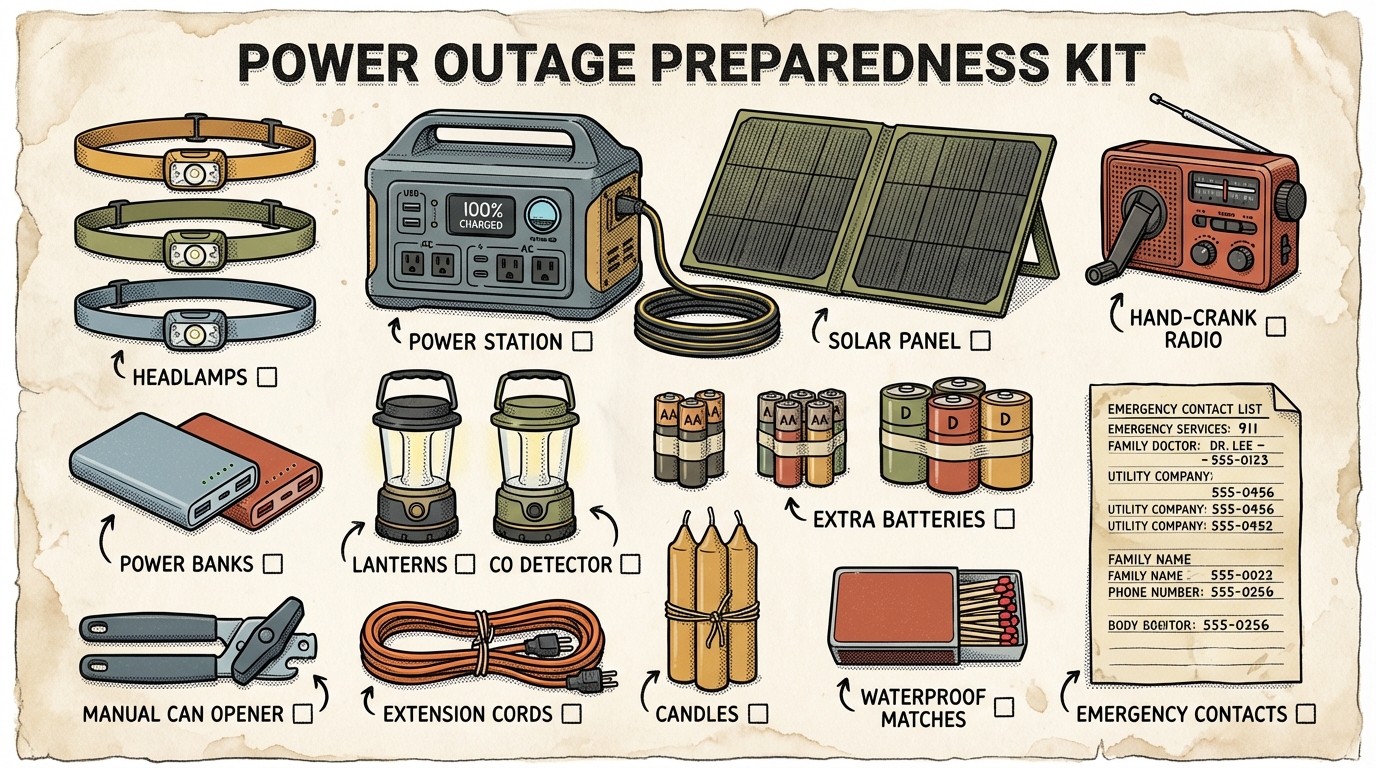
- Lighting: 2+ quality survival flashlights with spare lithium batteries, 1 LED lantern, solar garden lights, DIY candle supplies with fire-safe containers and a lighter.
- Power: Portable solar panel and battery bank (or solar generator), generator with safely stored fuel (stabilized gasoline or propane), heavy-duty extension cords.
- Communication: Battery-powered or hand-crank NOAA weather radio, fully charged portable phone charger.
- Food safety: Cooler with ice packs, non-perishable food (3-day minimum), manual can opener, food thermometer to check fridge/freezer temps.
- Comfort and safety: Blankets or sleeping bags (for heating loss), basic first aid kit, filled water containers (1 gallon per person per day), battery-powered carbon monoxide detector if using any fuel-burning device indoors.
Store this kit in one accessible location. Review and rotate perishable items and batteries every six months.
Building Your Plan: From Beginner to Blackout-Ready
Gear without a plan is just clutter. Here's how to move from unprepared to confident in stages:
- Week 1: Buy two quality flashlights and a pack of lithium batteries. Fill water containers. Identify your household's critical needs (medications, medical devices, infant supplies).
- Month 1: Add an LED lantern, a hand-crank radio, and a 3-day supply of non-perishable food. Make DIY emergency candles as a backup lighting project.
- Month 2-3: Invest in a portable solar panel and battery bank. Learn the basics of how solar power works — panels, charge controller, battery, inverter. Practice setting it up.
- Month 3-6: If you use a generator, establish a fuel storage rotation with stabilizer and approved containers. Build or install a DIY solar water heater for passive hot water.
- Ongoing: Test all gear every six months. Run a family blackout drill — turn off the main breaker for an evening and practice your plan.
The families I've worked with who do best in extended outages aren't the ones with the biggest budgets. They're the ones who practiced once before it mattered.
After riding out multi-day ice storm blackouts in the Pacific Northwest more times than I can count, I'll tell you this: your single best investment is a portable solar setup and two good flashlights — everything else is secondary. Generators are great, but fuel runs out and they're loud; solar is silent, indefinite, and getting cheaper every year. Start small, practice your plan in the dark, and you'll be calmer than 95% of your neighbors when the grid drops.
Get the Free Reference Guide
149 articles synthesized into one comprehensive PDF — free with your email.
You're in! Check your inbox for the free guide.
Unsubscribe anytime. We respect your privacy.
Deep-Dive Articles (9)
Best Survival Flashlights for Your Emergency Kit
Find the best survival flashlights for your emergency kit. Expert picks rated for brightness, durability, battery life & value. Build your kit today.
How to Build a Simple Solar Water Heater
Learn how to build a simple DIY solar water heater with basic tools, prepper-friendly materials, safety tips, and off-grid survival benefits.
Emergency Lighting: Bright Ideas for Dark Times
Learn the best emergency lighting options for beginners, including flashlights, lanterns, solar lights, and maintenance tips for blackout readiness.
How to Safely Store Fuel for Emergency Use
Learn how to store gasoline, diesel, and propane safely for emergencies with beginner-friendly tips on containers, shelf life, stabilizers, and fire safety.
How to Make Your Own Emergency Candles
Learn how to make DIY emergency candles with simple supplies, safety tips, and cost comparisons so you’re ready when the lights go out.
Prepping for Blackouts: Essential Tips and Gear
Learn how to prepare for blackouts with essential gear, backup power tips, and simple ways to keep your family safe, calm, and comfortable.
Prepping for Power Outages: Keeping the Lights On
Learn how to prepare for power outages with essential supplies, food safety tips, backup lighting, and communication strategies for stress-free blackouts.
How Solar Power Works: A Prepper's Off-Grid Guide
Learn how solar power works step by step and how to build a reliable off-grid emergency solar system. Practical sizing guide from a field-tested prepper.
Solar Power for Preppers: Harnessing the Sun's Energy
Learn how new preppers can use solar power for backup energy, including costs, components, setup steps, and portable options for emergencies.