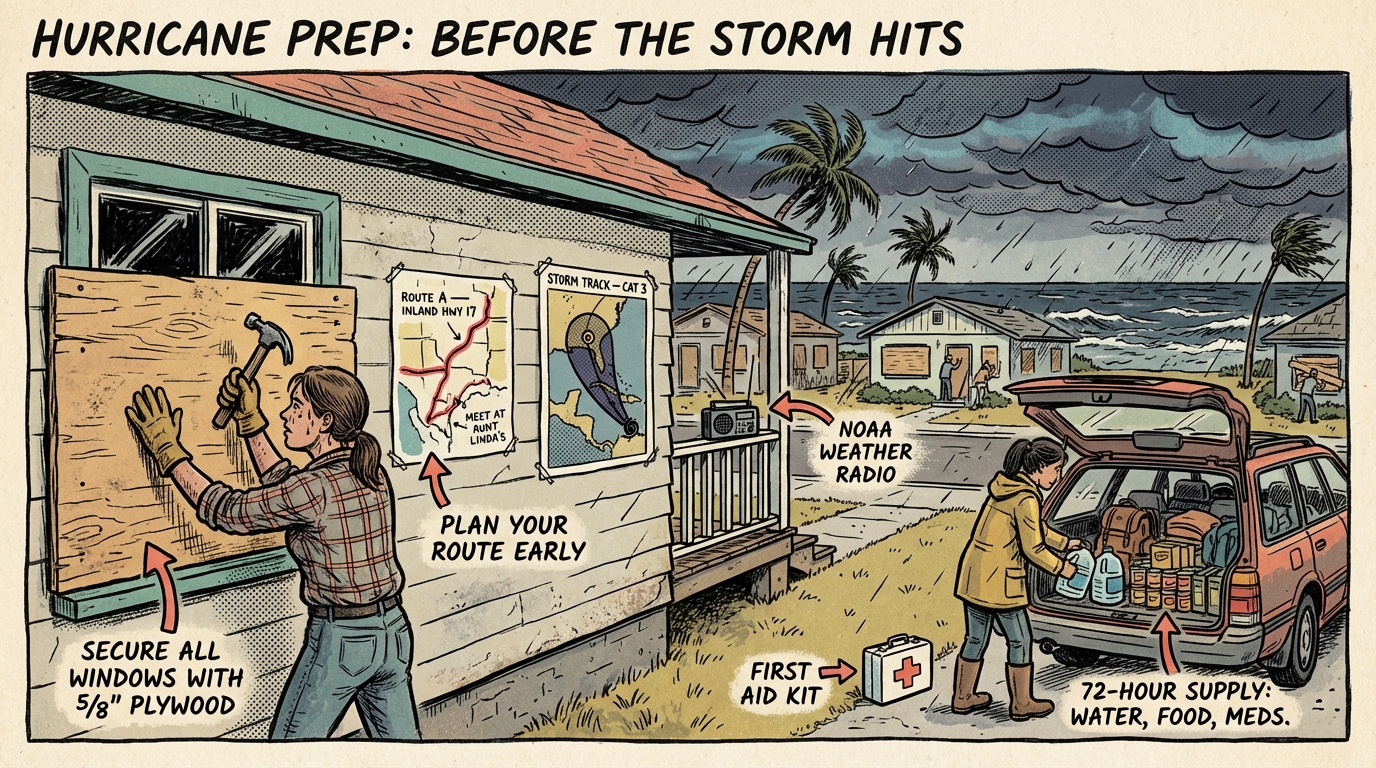
June–November Prep Checklist
- Store 1 gallon of water per person per day for 7 days in dedicated containers
- Build a 7-day supply of non-perishable food and a manual can opener
- Refill all prescriptions and store a 14-day medication supply in your kit
- Pre-cut and label plywood hurricane shutters for every window or install permanent shutters
- Keep your vehicle's gas tank at least half full from June through November
- Assemble a waterproof document bag with copies of IDs, insurance policies, and medical records
- Program your out-of-state emergency contact into every family member's phone and write it on laminated cards
- Purchase a NOAA weather radio with battery backup and test it monthly
- Stash $200 or more in small bills in your emergency kit
- Register elderly or special-needs household members with your county's special needs evacuation program
- Create a pet go-bag with food, medications, vaccination records, and a carrier
- Identify and drive your primary and alternate evacuation routes before June 1
Understanding the Threat: What Hurricanes Actually Do
Hurricanes are not just wind events. In fact, storm surge and inland flooding cause the majority of hurricane-related fatalities in the United States. A Category 1 storm can dump 15+ inches of rain hundreds of miles from the coast, while a Category 4 can push a wall of ocean water 15 feet above normal tide levels into coastal neighborhoods. Understanding the specific threats to your location changes everything about how you prepare.
- Storm surge: The deadliest hazard. If you're in a surge zone, evacuation is non-negotiable.
- Inland flooding: Flash floods from rainfall kill people well outside evacuation zones.
- Wind damage: Sustained winds above 110 mph destroy mobile homes and compromise older structures.
- Tornadoes: Hurricanes frequently spawn tornadoes in their outer rain bands.
- Power outages: Expect days to weeks without electricity after a major storm.
Look up your address on your county's storm surge map and FEMA's flood map service. Know your zone now, not when the forecast cone tightens.
Evacuate or Shelter in Place: Making the Decision Before the Storm
This is the most critical decision you'll make, and it needs to be made in advance. I tell every family I work with: decide your trigger points now and write them down. If you wait until a hurricane warning is issued to start debating, you've already lost hours — and possibly your best evacuation window.
- Evacuate if: You live in a designated storm surge zone, a mobile or manufactured home, a flood-prone area, or a high-rise building above the 10th floor (wind exposure).
- Shelter in place if: You are outside surge and flood zones, in a well-built concrete or reinforced structure, and have supplies to be self-sufficient for 7+ days.
Plan at least two evacuation routes — primary and alternate. Major highways gridlock fast. Know your county's evacuation zones (A, B, C) and which shelters correspond to each. Pre-identify a destination: a friend or family member's home inland is far better than a public shelter. Keep a full tank of gas in your vehicle from June through November — this single habit has saved more people from being stranded than any piece of gear I can recommend.
Building Your Hurricane Emergency Kit
Your hurricane kit is not a generic emergency bag — it's built for the specific scenario of days without power, potentially without running water, in a damaged or isolated structure. Here's what I actually recommend based on post-hurricane response work:
- Water: 1 gallon per person per day for a minimum of 7 days. For a family of four, that's 28 gallons. Store in dedicated containers, not random bottles.
- Food: 7-day supply of non-perishable food that requires no cooking. Canned goods, peanut butter, crackers, dried fruit, protein bars. Include a manual can opener.
- Medications: 14-day supply of all prescription medications. Request an emergency refill from your pharmacy before the season.
- Power: Battery bank (20,000+ mAh) for phones, hand-crank or battery-powered NOAA weather radio, LED headlamps with extra batteries.
- Documents: Waterproof container with copies of IDs, insurance policies, medical records, and a USB drive with digital backups.
- Cash: $200+ in small bills. ATMs and card readers go down when power does.
- Sanitation: Heavy-duty trash bags, moist towelettes, hand sanitizer, and a 5-gallon bucket with snap-on toilet seat lid for emergency sanitation.
Build this kit by mid-May. Shelves empty fast once a storm enters the Gulf.
Your Family Communication Plan
Cell towers get overwhelmed or knocked out during and after hurricanes. You need a communication plan that doesn't rely entirely on your smartphone working perfectly. Here's the framework I use and teach:
- Designate an out-of-state contact: One person everyone in your family checks in with. It's often easier to reach someone 500 miles away than across town.
- Write it down: Every family member carries a laminated card with emergency contact numbers, the out-of-state contact, your meeting points, and your evacuation destination. Phones die. Paper doesn't.
- Text, don't call: Text messages use far less bandwidth and are more likely to go through on a congested network.
- Establish two meeting points: One near your home (a neighbor's driveway) and one outside your neighborhood (a library, school, or church) in case you're separated.
- Register with FEMA's Safe and Well: After a disaster, the American Red Cross Safe and Well website lets you post your status so loved ones can find you.
Rehearse this plan once a year, ideally in May. A plan nobody remembers is not a plan.
Preparing Your Home to Shelter in Place
If you've determined your location is safe to ride out the storm, your home needs physical preparation. These steps should be completed 48–72 hours before projected landfall — not the day before, when hardware stores are stripped clean and you're fighting 30 mph gusts on a ladder.
- Windows: Install hurricane shutters or pre-cut 5/8-inch marine plywood panels. Label each panel for its window. Tape does nothing — skip it entirely.
- Yard: Bring in or secure all outdoor furniture, grills, potted plants, trash cans, and anything that becomes a projectile in 100+ mph winds.
- Garage door: This is the most vulnerable entry point. Reinforce with a garage door bracing kit — a failed garage door leads to catastrophic roof failure.
- Refrigerator: Set to the coldest setting 48 hours before the storm. Freeze containers of water to fill empty freezer space. A full freezer holds safe temperatures for 48 hours if the door stays closed.
- Bathtubs: Fill with water for flushing toilets and general sanitation — not drinking.
- Interior safe room: Identify the smallest interior room on the lowest floor with no windows. Stock it with your go-bag, shoes, helmets or bike helmets, and a mattress to pull over your family during the worst of it.
Special Considerations: Pets, Elderly Family, and Children
Generic preparedness advice often overlooks the people and animals who need the most help. Here's how to account for them specifically:
- Pets: Public shelters often don't accept animals. Identify pet-friendly shelters or hotels along your evacuation route now. Keep a pet go-bag with 7 days of food, medications, vaccination records, a photo of you with your pet (for proof of ownership), leash, carrier, and comfort items.
- Elderly or mobility-limited family: Register with your county's special needs registry — many jurisdictions offer priority evacuation assistance. Ensure backup power for medical devices like oxygen concentrators or CPAP machines. A small portable generator or medical-grade battery backup can be life-saving.
- Children: Talk to them about the plan in an age-appropriate way. Give them a role — packing their own bag, carrying the flashlight. Practice makes the real event far less traumatic. Pack familiar comfort items: a stuffed animal, a favorite book, coloring supplies.
- Important medications: If anyone in your household depends on refrigerated medication like insulin, invest in a small medical-grade cooler and cold packs rated for multi-day use.
The families I've seen handle disasters best are the ones who included everyone in the plan.
After the Storm: The 72 Hours That Matter Most
The storm passing is not the end of the emergency — it's the beginning of the recovery phase, which is often more dangerous than the storm itself. More people are injured or killed in the aftermath than during landfall.
- Do not go outside immediately. Wait for official all-clear from local emergency management. Eye-wall passage creates a deceptive calm.
- Avoid floodwater. It contains sewage, chemicals, downed power lines, and debris. Six inches of moving water can knock you down. Two feet will float your car.
- Document everything. Before you clean up, photograph and video all damage for insurance claims. Every room, every angle, every item.
- Generator safety: Run generators outdoors only, at least 20 feet from windows and doors. Carbon monoxide poisoning kills people after every single major hurricane. This is not optional guidance.
- Check on neighbors: Especially elderly, disabled, or those living alone. Community resilience is the most underrated survival tool in existence.
- Boil water: Assume tap water is compromised until your utility confirms otherwise.
Stay patient. Recovery takes longer than anyone expects, and the first 72 hours set the tone for everything that follows.
I've worked hurricane aftermath operations, and I'll tell you the single biggest difference between families who recover fast and those who don't: they made decisions in May, not in the cone of uncertainty in September. Buy the water now. Cut the plywood now. Fill the prescriptions now. The supplies are cheap and available today — they'll be gone when you actually need them. Preparedness isn't about fear, it's about buying yourself the freedom to stay calm when everyone around you is panicking.
Get the Free Reference Guide
149 articles synthesized into one comprehensive PDF — free with your email.
You're in! Check your inbox for the free guide.
Unsubscribe anytime. We respect your privacy.
Related Guides
Beginner Prepper Guide: Mindset, Supplies & Skills
New to prepping? This beginner prepper guide covers the preparedness mindset, essential supplies, skills, and mistakes to avoid. Start building readiness today.
Beginner Prepping Basics: Start Survivalism the Right Way
Learn beginner prepping basics from a FEMA-trained responder. Practical steps, budget-friendly gear, and common mistakes to avoid. Start prepping today.
The Best Portable Water Filters for Safe Drinking
Discover the best portable water filters for beginners, how they work, what features matter most, and which models are worth your money.
Best Water Storage Tanks for Preppers (2025 Guide)
Find the best water storage tanks for preppers — beginner picks, sizing guide, and maintenance tips from a Wilderness First Responder. Start storing today.
Emergency Water Preparedness: Store, Purify & Plan
Build your emergency water preparedness plan with proven strategies for storage, purification, and rationing from a FEMA-trained WFR. Start your water plan today.
Gadgets and Gizmos Aplenty: Tech Tools for the Modern Prepper
Discover the best survival gadgets for beginners, from power banks to water filters, and learn how smart tech makes emergency preparedness easier.
How to Make a DIY Water Filter Using Household Items
Learn how to make a DIY water filter with household items, plus safety tips, step-by-step instructions, and how to make water safer to drink.
How to Store Water for Emergencies: Complete Guide
Learn how to store water for emergencies — the right containers, purification methods, rotation tips, and a budget plan. Start your supply today.
How to Identify Safe Drinking Water in the Wild
Learn how to find, judge, and purify drinking water in the wild with beginner-friendly survival tips for safer hydration anywhere.
Rainwater Harvesting: Mother Nature's Free Water Supply
Learn how to set up a beginner-friendly rainwater harvesting system, store emergency water, follow regulations, and purify it safely.
Survival Skills for Beginners: What Every New Prepper Needs
Master essential survival skills for beginners — water, shelter, fire, first aid & navigation. Field-tested techniques from a Wilderness First Responder.
Top 5 Water Filtration Systems for New Preppers
Discover the best water filtration systems for new preppers, including beginner-friendly picks, buying tips, maintenance advice, and common mistakes.